Ch. 8 - Microbial Genetics
Tortora - Microbiology: An Introduction 14th Edition
Tortora14th EditionMicrobiology: An IntroductionISBN: 9780138200398당신이 사용하는 게 아니라요?교과서 변경
8장, 문제 3

Feedback inhibition differs from repression because feedback inhibition
a. Is less precise.
b. Is slower acting.
c. Stops the action of preexisting enzymes.
d. Stops the synthesis of new enzymes.
e. All of the above

검증된 단계별 안내
1
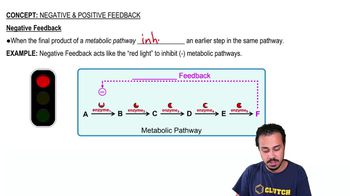
Understand the concept of feedback inhibition: it is a regulatory mechanism where the end product of a metabolic pathway directly inhibits an enzyme involved earlier in the pathway, usually by binding to the enzyme and altering its activity.
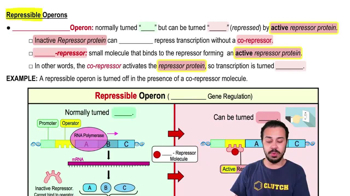
Understand the concept of repression: it is a regulatory mechanism that controls gene expression by preventing the synthesis of enzymes, typically by inhibiting transcription of the genes encoding those enzymes.
Compare the two mechanisms: feedback inhibition acts on enzymes that are already present (preexisting enzymes), quickly stopping their activity, whereas repression prevents the production of new enzymes by stopping gene expression.
Analyze the options given: option (c) states that feedback inhibition stops the action of preexisting enzymes, which aligns with the definition of feedback inhibition; option (d) refers to stopping synthesis of new enzymes, which is characteristic of repression.
Conclude that feedback inhibition differs from repression primarily because it acts faster by inhibiting enzyme activity directly rather than controlling enzyme synthesis, so the correct distinguishing feature is that feedback inhibition stops the action of preexisting enzymes.

비슷한 문제에 대한 검증된 영상 답변:

이 영상 해법은 위 문제에 도움이 된다고 튜터들이 추천한 것입니다.
영상 길이:
1m
도움이 되었나요?

주요 개념

질문에 올바르게 답하기 위해 반드시 이해해야 하는 핵심 개념들은 다음과 같습니다.

Feedback Inhibition

Feedback inhibition is a regulatory mechanism where the end product of a metabolic pathway binds to an enzyme involved earlier in the pathway, inhibiting its activity. This process quickly stops the function of existing enzymes to prevent overproduction of the product, allowing rapid response to cellular needs.
추천 영상:
가이드 코스
02:41
Negative Feedback

Repression

Repression is a gene-level control mechanism that decreases or stops the synthesis of enzymes by inhibiting transcription. It acts more slowly than feedback inhibition because it prevents the production of new enzymes rather than affecting enzymes already present.
추천 영상:
가이드 코스
03:42
Repressible Operons

Differences Between Feedback Inhibition and Repression

The key difference is that feedback inhibition acts directly and rapidly on existing enzymes to halt their activity, while repression controls enzyme levels by regulating gene expression, which is slower. Feedback inhibition is more precise in immediate response, whereas repression affects enzyme synthesis over time.
추천 영상:
가이드 코스
02:41
Negative Feedback
관련 실천
교과서 질문

Transfer of DNA from a donor to a recipient as naked DNA in solution.

a. Conjugation

b. Transcription

c. Transduction

d. Transformation

e. Translation

886
views

교과서 질문

Match the following examples of mutagens.

1602
views
교과서 질문

The following is a code for a strand of DNA.

a. Using the genetic code provided in Figure 8.8, fill in the blanks to complete the segment of DNA shown.

b. Fill in the blanks to complete the sequence of amino acids coded for by this strand of DNA.

c. Write the code for the complementary strand of DNA completed in part (a).

d. What would be the effect if C were substituted for T at base 10?

e. What would be the effect if A were substituted for G at base 11?

f. What would be the effect if G were substituted for T at base 14?

g. What would be the effect if C were inserted between bases 9 and 10?

h. How would UV radiation affect this strand of DNA?

i. Identify a nonsense sequence in this strand of DNA.

1491
views
교과서 질문

Suppose you inoculate three flasks of minimal salts broth with E. coli. Flask A contains glucose. Flask B contains glucose and lactose. Flask C contains lactose. After a few hours of incubation, you test the flasks for the presence of ß-galactosidase. Which flask(s) do you predict will have this enzyme?

a. A

b. B

c. C

d. A and B

e. B and C

1524
views
교과서 질문

Identify and mark each of the following on the portion of DNA undergoing replication: replication fork, DNA polymerase, RNA primer, parent strands, leading strand, lagging strand, the direction of replication on each strand, and the 5′ end of each strand.

1482
views
교과서 질문

Bacteria can acquire antibiotic resistance by all of the following except

a. mutation.

b. insertion of transposons.

c. conjugation.

d. snRNPs.

e. transformation.

1881
views