Ch. 8 - Microbial Genetics
Tortora - Microbiology: An Introduction 14th Edition
Tortora14th EditionMicrobiology: An IntroductionISBN: 9780138200398당신이 사용하는 게 아니라요?교과서 변경
8장, 문제 6

Identify when (before transcription, after transcription but before translation, after translation) each of the following regulatory mechanisms functions.
a. ATP combines with an enzyme, altering its shape.
b. A short RNA is synthesized that is complementary to mRNA.
c. Methylation of DNA occurs.
d. An inducer combines with a repressor.

검증된 단계별 안내
1
Step 1: Understand the stages of gene expression regulation: before transcription (DNA level), after transcription but before translation (RNA level), and after translation (protein level).
Step 2: For (a) ATP combining with an enzyme and altering its shape, recognize this as allosteric regulation of enzyme activity, which occurs after translation since it affects the protein directly.
Step 3: For (b) a short RNA synthesized complementary to mRNA, identify this as RNA interference or antisense RNA action, which regulates gene expression after transcription but before translation by binding mRNA and preventing its translation.
Step 4: For (c) methylation of DNA, understand that this is a modification at the DNA level that affects gene expression by preventing transcription, so it occurs before transcription.
Step 5: For (d) an inducer combining with a repressor, know that this interaction typically affects the repressor's ability to bind DNA and thus regulates transcription initiation, so it occurs before transcription.

비슷한 문제에 대한 검증된 영상 답변:

이 영상 해법은 위 문제에 도움이 된다고 튜터들이 추천한 것입니다.
영상 길이:
2m
도움이 되었나요?

주요 개념

질문에 올바르게 답하기 위해 반드시 이해해야 하는 핵심 개념들은 다음과 같습니다.

Regulation Before Transcription

This level of regulation controls gene expression by modifying DNA or DNA-binding proteins before RNA synthesis begins. Examples include DNA methylation, which can silence genes by preventing transcription factor binding, and the interaction of inducers with repressors to control operon activity. These mechanisms determine whether transcription is initiated.
추천 영상:
가이드 코스
05:17
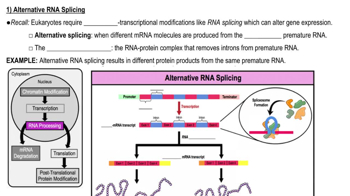
Eukaryotic Post-Transcriptional Regulation

Regulation After Transcription but Before Translation

This stage involves control mechanisms acting on RNA molecules after they are synthesized but before they are translated into proteins. For instance, short complementary RNAs (like antisense RNA) can bind to mRNA, blocking its translation or promoting degradation, thus preventing protein synthesis without altering transcription.
추천 영상:
가이드 코스
03:55
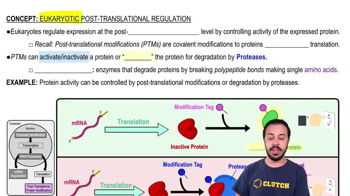
Eukaryotic Post-Translational Regulation

Regulation After Translation

Post-translational regulation modifies the activity of proteins after they are produced. An example is the binding of ATP to an enzyme, causing a conformational change that alters its function. This allows cells to rapidly adjust enzyme activity in response to environmental or metabolic signals without changing gene expression.
추천 영상:
가이드 코스
03:55
Eukaryotic Post-Translational Regulation
관련 실천
교과서 질문

Use the following choices to answer the question:

a. Catabolite repression

b. DNA polymerase

c. Induction

d. Repression

e. Translation


Mechanism by which the presence of glucose inhibits the lac operon.

1199
views

교과서 질문

The following is a code for a strand of DNA.

a. Using the genetic code provided in Figure 8.8, fill in the blanks to complete the segment of DNA shown.

b. Fill in the blanks to complete the sequence of amino acids coded for by this strand of DNA.

c. Write the code for the complementary strand of DNA completed in part (a).

d. What would be the effect if C were substituted for T at base 10?

e. What would be the effect if A were substituted for G at base 11?

f. What would be the effect if G were substituted for T at base 14?

g. What would be the effect if C were inserted between bases 9 and 10?

h. How would UV radiation affect this strand of DNA?

i. Identify a nonsense sequence in this strand of DNA.

1491
views
교과서 질문

Use the following choices to answer the question:

a. Catabolite repression

b. DNA polymerase

c. Induction

d. Repression

e. Translation


The mechanism by which lactose controls the lac operon.

815
views
교과서 질문

Which sequence is the best target for damage by UV radiation: AGGCAA, CTTTGA, or GUAAAU? Why aren’t all bacteria killed when they are exposed to sunlight?

1621
views
교과서 질문

Suppose you inoculate three flasks of minimal salts broth with E. coli. Flask A contains glucose. Flask B contains glucose and lactose. Flask C contains lactose. After a few hours of incubation, you test the flasks for the presence of ß-galactosidase. Which flask(s) do you predict will have this enzyme?

a. A

b. B

c. C

d. A and B

e. B and C

1524
views
교과서 질문

Plasmids differ from transposons in that plasmids

a. become inserted into chromosomes.

b. are self-replicated outside the chromosome.

c. move from chromosome to chromosome.

d. carry genes for antibiotic resistance.

e. none of the above

1457
views