Skip to main content
Microeconomics
나의 코스
배우기
시험 준비
AI 튜터
학습 가이드
플래시카드
탐험해 보세요
앱을 사용해 보세요
나의 코스
배우기
시험 준비
AI 튜터
학습 가이드
플래시카드
탐험해 보세요
앱을 사용해 보세요
뒤로
AE Model: Algebraic Approach definitions
카드를 뒤집기 위해 탭할 수 있습니다.
Macroeconomic Equilibrium
카드를 뒤집기 위해 탭할 수 있습니다.
👆
Macroeconomic Equilibrium
Occurs when total spending in the economy matches the value of goods and services produced, ensuring stability in output.
진행 상황 추적
컨트롤 버튼이 '내비게이션' 모드로 변경되었습니다.
1/15
관련 플래시카드
추천 영상
AE Model: Algebraic Approach quiz
AE Model: Algebraic Approach
15 용어
VideoThumbView.guidedCourse
04:46
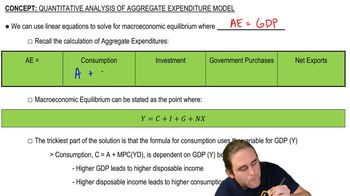
Aggregate Expenditures
4
views
VideoThumbView.guidedCourse
02:20
Algebraic Approach to the AE Model
4
views
이 집합의 용어 (15)
하이드의 정의
Macroeconomic Equilibrium
Occurs when total spending in the economy matches the value of goods and services produced, ensuring stability in output.
Aggregate Expenditures
Represents the sum of spending by households, businesses, government, and foreign buyers on goods and services.
Real GDP
Measures the total value of all final goods and services produced, adjusted for inflation, reflecting economic output.
Consumption
Refers to household spending on goods and services, influenced by income levels and economic conditions.
Disposable Income
Denotes the amount of income available to households after taxes, used for spending or saving.
Marginal Propensity to Consume
Indicates the fraction of additional income that households spend rather than save, shaping consumption patterns.
Market Equilibrium
Describes the point where supply and demand balance, resulting in stable prices and quantities.
Demand Curve
Illustrates the relationship between price and quantity demanded, typically sloping downward.
Economic Profits
Represents the surplus earned after accounting for all costs, including opportunity costs, in production.
Marginal Costs
Reflects the increase in total cost from producing one more unit of output, guiding production decisions.
Market Supply
Shows the total quantity of a good or service that producers are willing to offer at various prices.
Income
Signifies earnings from work, investments, or business, forming the basis for spending and saving.
Linear Equation
Expresses a straight-line relationship between variables, used to model economic interactions algebraically.
Base Consumption
Represents the minimum level of household spending, independent of income, in consumption models.
Aggregate Supply
Captures the total output of goods and services that producers are willing to supply at different price levels.
 뒤로뒤로
뒤로뒤로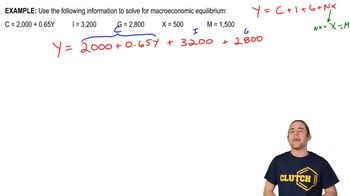
 04:46
04:46