Skip to main content
Microeconomics
나의 코스
배우기
시험 준비
AI 튜터
학습 가이드
플래시카드
탐험해 보세요
앱을 사용해 보세요
나의 코스
배우기
시험 준비
AI 튜터
학습 가이드
플래시카드
탐험해 보세요
앱을 사용해 보세요
뒤로
Arguments Against International Trade definitions
카드를 뒤집기 위해 탭할 수 있습니다.
Protectionism
카드를 뒤집기 위해 탭할 수 있습니다.
👆
Protectionism
Policy designed to shield domestic industries from foreign competition, often through tariffs or quotas.
진행 상황 추적
컨트롤 버튼이 '내비게이션' 모드로 변경되었습니다.
1/15
관련 플래시카드
관련 실천
추천 영상
Arguments Against International Trade quiz #1
Arguments Against International Trade
10 용어
Arguments Against International Trade
9. International Trade
10 문제점
주제
Import Quotas and VERs
9. International Trade
10 문제점
주제
9. International Trade
5 주제
15 문제점
장
VideoThumbView.guidedCourse
07:50
Arguments Against International Trade
2193
views
34
rank
이 집합의 용어 (15)
하이드의 정의
Protectionism
Policy designed to shield domestic industries from foreign competition, often through tariffs or quotas.
Comparative Advantage
Ability of a country to produce a good at a lower opportunity cost than others, guiding trade patterns.
Jobs Argument
Claim that international trade causes job losses in certain sectors, but shifts employment to areas of strength.
National Security
Concern over trading resources that could be used by adversaries, with unclear boundaries on what poses a risk.
Infant Industry
New domestic sector needing protection from established foreign competitors, often requiring government intervention.
Government Speculation
Process where authorities attempt to predict which industries will succeed, often seen as outside their expertise.
Unfair Competition
Situation where foreign firms benefit from subsidies or different regulations, potentially disadvantaging local producers.
Consumer Surplus
Benefit received by buyers when goods are available at lower prices, often increased by international trade.
Total Surplus
Combined gains of consumers and producers in a market, typically enhanced by open trade.
Bargaining Chip
Trade restriction used as leverage in negotiations, which can risk political reputation if unsuccessful.
Tariff
Tax imposed on imported goods, commonly used to protect domestic industries or as a negotiation tool.
Economies of Scale
Cost advantages gained by increasing production, often realized through access to larger international markets.
Variety of Goods
Expanded selection of products available to consumers due to international trade.
Competition
Rivalry among firms in a global market, leading to greater efficiency and lower prices.
Flow of Ideas
Exchange of knowledge and technology across borders, facilitated by international trade.
 뒤로뒤로
뒤로뒤로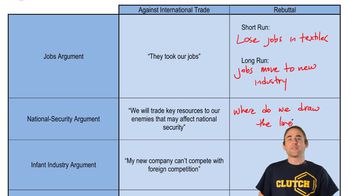
 07:50
07:50