Skip to main content
Microeconomics
나의 코스
배우기
시험 준비
AI 튜터
학습 가이드
플래시카드
탐험해 보세요
앱을 사용해 보세요
나의 코스
배우기
시험 준비
AI 튜터
학습 가이드
플래시카드
탐험해 보세요
앱을 사용해 보세요
뒤로
Average Total Cost: Short Run and Long Run definitions
카드를 뒤집기 위해 탭할 수 있습니다.
Short Run
카드를 뒤집기 위해 탭할 수 있습니다.
👆
Short Run
A period where some costs remain fixed due to prior commitments, limiting flexibility in production decisions.
진행 상황 추적
컨트롤 버튼이 '내비게이션' 모드로 변경되었습니다.
1/15
관련 플래시카드
관련 실천
추천 영상
Average Total Cost: Short Run and Long Run quiz #1
Average Total Cost: Short Run and Long Run
10 용어
Average Total Cost: Short Run and Long Run
10. The Costs of Production
9 문제점
주제
Isoquant Lines
10. The Costs of Production
10 문제점
주제
10. The Costs of Production
9 주제
15 문제점
장
VideoThumbView.guidedCourse
13:13
ATC in the Short Run and Long Run
3074
views
27
rank
이 집합의 용어 (15)
하이드의 정의
Short Run
A period where some costs remain fixed due to prior commitments, limiting flexibility in production decisions.
Long Run
A timeframe in which all costs become variable, allowing firms to adjust production capacity and reevaluate past choices.
Fixed Costs
Expenses that do not change with output in the short run, often resulting from contracts or investments.
Variable Costs
Expenses that fluctuate with production levels, becoming adjustable in the long run.
Average Total Cost
The per-unit expense of production, combining both fixed and variable costs, depicted as a curve on a graph.
Short Run Average Total Cost Curve
A graphical representation showing how per-unit costs change with output when some costs are fixed.
Long Run Average Total Cost Curve
A curve tracing the lowest possible per-unit costs across all short run scenarios as output varies.
Economies of Scale
A phase where increasing output leads to lower per-unit costs due to factors like specialization and bulk purchasing.
Constant Returns to Scale
A range where per-unit costs remain stable as output increases, indicating optimal production efficiency.
Diseconomies of Scale
A situation where expanding output causes per-unit costs to rise, often due to coordination and management challenges.
Minimum Efficient Scale
The smallest output level at which all cost-saving benefits from economies of scale are fully realized.
Specialization
The process of assigning specific tasks to workers, enhancing productivity and reducing costs in early production stages.
Bulk Purchasing
Acquiring large quantities of inputs to secure discounts, contributing to lower per-unit costs.
Production Capacity
The maximum output a firm can achieve based on its current resources and facility size.
Coordination Problems
Difficulties in managing large-scale operations, leading to inefficiencies and higher costs as firms grow.
 뒤로뒤로
뒤로뒤로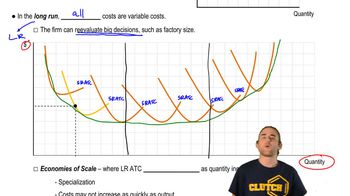
 13:13
13:13