Skip to main content
Microeconomics
나의 코스
배우기
시험 준비
AI 튜터
학습 가이드
플래시카드
탐험해 보세요
앱을 사용해 보세요
나의 코스
배우기
시험 준비
AI 튜터
학습 가이드
플래시카드
탐험해 보세요
앱을 사용해 보세요
뒤로
Classical Model and Keynesian Model definitions
카드를 뒤집기 위해 탭할 수 있습니다.
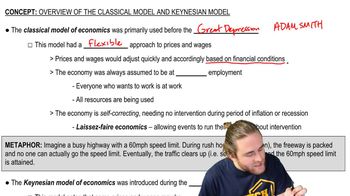
Classical Model
카드를 뒤집기 위해 탭할 수 있습니다.
👆
Classical Model
Economic framework assuming flexible prices and wages, full employment, and self-correcting markets without government intervention.
진행 상황 추적
컨트롤 버튼이 '내비게이션' 모드로 변경되었습니다.
1/15
관련 플래시카드
추천 영상
Classical Model and Keynesian Model quiz
Classical Model and Keynesian Model
15 용어
VideoThumbView.guidedCourse
03:04
Keynesian Model
5
views
VideoThumbView.guidedCourse
02:54
Classical Model
4
views
VideoThumbView.guidedCourse
03:41
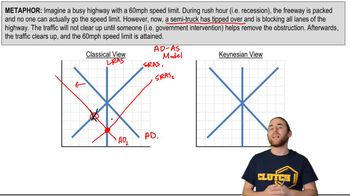
Graphical Comparison of Classical Model and Keynesian Model
3
views
이 집합의 용어 (15)
하이드의 정의
Classical Model
Economic framework assuming flexible prices and wages, full employment, and self-correcting markets without government intervention.
Keynesian Model
Economic theory emphasizing sticky prices and wages, unemployment, and the necessity of government intervention during recessions and inflation.
Flexible Prices
Market condition where prices adjust quickly in response to changes in supply and demand, enabling rapid equilibrium restoration.
Sticky Wages
Situation where wage levels remain unchanged despite shifts in economic conditions, often due to contracts or institutional factors.
Full Employment
State where all available labor resources are being used efficiently, and anyone seeking work can find a job.
Self-Correcting Market
Economic system that naturally returns to equilibrium without external intervention, relying on internal adjustments.
Laissez-Faire
Principle advocating minimal government involvement in economic affairs, allowing markets to operate freely.
Government Intervention
Actions by authorities to influence economic outcomes, such as addressing recessions or inflation through policy measures.
Aggregate Demand
Total spending on goods and services within an economy, represented as a downward-sloping curve in macroeconomic models.
Aggregate Supply
Total output of goods and services produced by an economy, depicted as both short-run and long-run curves in models.
Short Run Equilibrium
Temporary state where aggregate demand and aggregate supply intersect, not necessarily at potential GDP.
Long Run Equilibrium
Condition where aggregate demand, short-run aggregate supply, and long-run aggregate supply meet at potential GDP.
Potential GDP
Maximum sustainable output an economy can produce when all resources are fully employed.
Recession
Period of economic decline marked by reduced aggregate demand, increased unemployment, and lower output.
Invisible Hand
Metaphor for the self-regulating nature of markets, guiding resources to their most efficient uses without direct intervention.
 뒤로뒤로
뒤로뒤로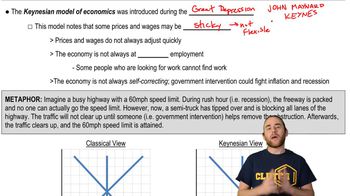
 03:04
03:04