Skip to main content
Microeconomics
나의 코스
배우기
시험 준비
AI 튜터
학습 가이드
플래시카드
탐험해 보세요
앱을 사용해 보세요
나의 코스
배우기
시험 준비
AI 튜터
학습 가이드
플래시카드
탐험해 보세요
앱을 사용해 보세요
뒤로
Cross-Price Elasticity of Demand definitions
카드를 뒤집기 위해 탭할 수 있습니다.
Cross Price Elasticity
카드를 뒤집기 위해 탭할 수 있습니다.
👆
Cross Price Elasticity
Measures how the demand for one item responds to a price change in another, revealing their relationship as substitutes, complements, or unrelated.
진행 상황 추적
컨트롤 버튼이 '내비게이션' 모드로 변경되었습니다.
1/15
관련 플래시카드
관련 실천
추천 영상
Cross-Price Elasticity of Demand quiz #1
Cross-Price Elasticity of Demand
11 용어
Cross-Price Elasticity of Demand
4. Elasticity
10 문제점
주제
Price Elasticity of Supply
4. Elasticity
10 문제점
주제
4. Elasticity
11 주제
15 문제점
장
VideoThumbView.guidedCourse
07:14
Cross-Price Elasticity of Demand
3388
views
29
rank
이 집합의 용어 (15)
하이드의 정의
Cross Price Elasticity
Measures how the demand for one item responds to a price change in another, revealing their relationship as substitutes, complements, or unrelated.
Substitutes
Goods where a price increase in one leads to higher demand for the other, indicated by a positive cross price elasticity.
Complements
Goods where a price increase in one causes lower demand for the other, shown by a negative cross price elasticity.
Unrelated Goods
Items whose price changes have no effect on each other's demand, resulting in a cross price elasticity of zero.
Midpoint Method
A calculation technique using averages of initial and final values to determine percentage changes for elasticity measures.
Quantity Demanded
The amount of a product consumers are willing to purchase at a specific price, used in elasticity calculations.
Numerator
The top part of the elasticity formula, representing the percentage change in quantity demanded.
Denominator
The bottom part of the elasticity formula, representing the percentage change in price of another good.
Percentage Change
A value showing how much a variable shifts relative to its average, crucial for elasticity calculations.
Positive Value
An elasticity result indicating that goods are substitutes, as both price and demand move in the same direction.
Negative Value
An elasticity result showing goods are complements, as price and demand move in opposite directions.
Zero Value
An elasticity outcome signifying no relationship between goods, as price changes do not affect demand.
Demand Shift
A change in consumer purchasing patterns due to external factors, such as price changes in related goods.
Elasticity Formula
An equation relating percentage changes in quantity and price to determine the responsiveness of demand.
Analysis
The process of interpreting elasticity results to classify goods as substitutes, complements, or unrelated.
 뒤로뒤로
뒤로뒤로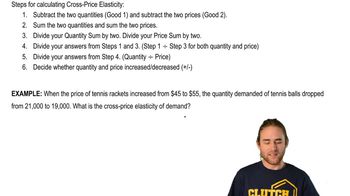
 07:14
07:14