Skip to main content
Microeconomics
나의 코스
배우기
시험 준비
AI 튜터
학습 가이드
플래시카드
탐험해 보세요
앱을 사용해 보세요
나의 코스
배우기
시험 준비
AI 튜터
학습 가이드
플래시카드
탐험해 보세요
앱을 사용해 보세요
뒤로
Dynamic AD-AS Model: Introduction quiz
카드를 뒤집기 위해 탭할 수 있습니다.
What are the two main unrealistic assumptions of the traditional AD-AS model?
카드를 뒤집기 위해 탭할 수 있습니다.
👆
What are the two main unrealistic assumptions of the traditional AD-AS model?
The traditional AD-AS model assumes there is no long-run inflation and no long-run economic growth.
진행 상황 추적
컨트롤 버튼이 '내비게이션' 모드로 변경되었습니다.
1/15
관련 플래시카드
추천 영상
Dynamic AD-AS Model: Introduction definitions
Dynamic AD-AS Model: Introduction
15 용어
04:59
Dynamic AD-AS Model: Introduction
6
views
이 집합의 용어 (15)
하이드의 정의
What are the two main unrealistic assumptions of the traditional AD-AS model?
The traditional AD-AS model assumes there is no long-run inflation and no long-run economic growth.
Why does the traditional AD-AS model struggle with long-term economic predictions?
Because it assumes economies do not grow or experience inflation over time, which is not true in reality.
How does the traditional AD-AS model incorrectly predict recessions?
It predicts that recessions are often accompanied by falling prices, which rarely happens in modern economies.
What is the main improvement of the dynamic AD-AS model over the traditional model?
The dynamic AD-AS model allows aggregate demand and supply curves to shift over time, reflecting real-world changes.
Why is the dynamic AD-AS model called 'dynamic'?
Because it allows all three curves—aggregate demand, short-run aggregate supply, and long-run aggregate supply—to change over time.
What does the long-run aggregate supply curve represent?
It represents the potential GDP of the economy if it is operating at full employment.
What typically causes the long-run aggregate supply curve to shift to the right over time?
Population growth and technological advances increase the economy's productive capacity.
Why does the short-run aggregate supply curve also shift to the right over time?
For the same reasons as long-run aggregate supply: population growth and technological improvements.
What are the main reasons aggregate demand increases over time?
Rising consumption, increased investment, and higher government spending due to population growth.
How does the dynamic AD-AS model address the issue of price levels during recessions?
It recognizes that prices do not necessarily fall during recessions, unlike the prediction of the traditional model.
What does the dynamic AD-AS model show about equilibrium price levels and output?
It shows how equilibrium price levels and output evolve dynamically over time.
Why might government spending increase as the population grows?
Because it costs more to provide the same basic services to a larger population.
How does investment respond to shifts in aggregate supply in the dynamic model?
As aggregate supply shifts right, businesses see more opportunities and are likely to invest more.
What limitation of the traditional AD-AS model is addressed by the dynamic model regarding equilibrium?
The dynamic model shows that economies do not return to the same equilibrium repeatedly, unlike the traditional model's prediction.
What will be discussed in the next lesson about the dynamic AD-AS model?
How different rates of movement in the curves can lead to various macroeconomic situations.
 뒤로뒤로
뒤로뒤로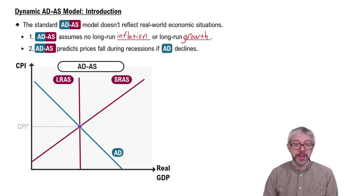
 04:59
04:59