Skip to main content
Microeconomics
나의 코스
배우기
시험 준비
AI 튜터
학습 가이드
플래시카드
탐험해 보세요
앱을 사용해 보세요
나의 코스
배우기
시험 준비
AI 튜터
학습 가이드
플래시카드
탐험해 보세요
앱을 사용해 보세요
뒤로
Elasticity Summary definitions
카드를 뒤집기 위해 탭할 수 있습니다.
Price Elasticity of Demand
카드를 뒤집기 위해 탭할 수 있습니다.
👆
Price Elasticity of Demand
Measures how much quantity demanded changes in response to a price change, using percentage changes and absolute values.
진행 상황 추적
컨트롤 버튼이 '내비게이션' 모드로 변경되었습니다.
1/15
관련 플래시카드
관련 실천
추천 영상
Elasticity Summary quiz #1
Elasticity Summary
13 용어
Elasticity Summary
4. Elasticity
10 문제점
주제
Price Elasticity of Supply on a Graph
4. Elasticity
10 문제점
주제
4. Elasticity
11 주제
15 문제점
장
VideoThumbView.guidedCourse
04:06
Elasticity Summary
3715
views
28
rank
1
comments
이 집합의 용어 (15)
하이드의 정의
Price Elasticity of Demand
Measures how much quantity demanded changes in response to a price change, using percentage changes and absolute values.
Price Elasticity of Supply
Indicates how quantity supplied responds to price changes, calculated with percentage changes and always positive values.
Income Elasticity of Demand
Shows how quantity demanded shifts when consumer income changes, with sign revealing if goods are normal or inferior.
Cross-Price Elasticity of Demand
Reveals how quantity demanded of one good changes when the price of another good changes, signifying substitutes or complements.
Midpoint Method
A calculation technique using averages to find percentage changes, ensuring consistent elasticity results regardless of direction.
Absolute Value
Ensures elasticity calculations for price are always positive, simplifying interpretation of responsiveness.
Normal Good
A product whose demand increases as consumer income rises, identified by positive income elasticity.
Inferior Good
A product whose demand decreases as consumer income rises, indicated by negative income elasticity.
Substitute
A good whose demand rises when the price of another good increases, shown by positive cross-price elasticity.
Complement
A good whose demand falls when the price of another good increases, reflected by negative cross-price elasticity.
Elastic Demand
Occurs when the elasticity value exceeds one, meaning quantity demanded changes more than price changes.
Inelastic Demand
Exists when elasticity is less than one, so quantity demanded changes less than price changes.
Unit Elastic
A point where elasticity equals one, marking maximum total revenue on the demand curve.
Total Revenue
Calculated as price times quantity sold, its relationship with price changes depends on elasticity.
Demand Curve
A graphical representation showing how quantity demanded varies with price, highlighting elastic, inelastic, and unit elastic regions.
 뒤로뒤로
뒤로뒤로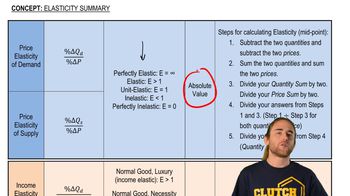
 04:06
04:06