Skip to main content
Microeconomics
나의 코스
배우기
시험 준비
AI 튜터
학습 가이드
플래시카드
탐험해 보세요
앱을 사용해 보세요
나의 코스
배우기
시험 준비
AI 튜터
학습 가이드
플래시카드
탐험해 보세요
앱을 사용해 보세요
뒤로
Goals of Monetary Policy definitions
카드를 뒤집기 위해 탭할 수 있습니다.
Monetary Policy
카드를 뒤집기 위해 탭할 수 있습니다.
👆
Monetary Policy
Management of the money supply by the central bank to achieve macroeconomic objectives such as stability and growth.
진행 상황 추적
컨트롤 버튼이 '내비게이션' 모드로 변경되었습니다.
1/14
관련 플래시카드
추천 영상
Goals of Monetary Policy quiz
Goals of Monetary Policy
15 용어
VideoThumbView.guidedCourse
03:28
Goals of Monetary Policy
5
views
이 집합의 용어 (14)
하이드의 정의
Monetary Policy
Management of the money supply by the central bank to achieve macroeconomic objectives such as stability and growth.
Federal Reserve
Central bank of the United States responsible for regulating the money supply and ensuring financial stability.
Money Supply
Total amount of currency and liquid assets available in an economy, including M1 and M2.
M1
Narrow measure of money including cash, checking accounts, and other highly liquid assets.
M2
Broader measure of money including M1 plus savings accounts, time deposits, and other near-money assets.
Price Stability
Condition where inflation is controlled, preserving the purchasing power and value of money over time.
Inflation
General increase in prices, reducing the value of money and affecting economic decisions.
Employment
Level of job availability in the economy, reflecting the use of resources and supporting GDP.
Investment
Allocation of funds by firms to acquire capital, driving economic growth and job creation.
Interest Rate
Cost of borrowing money, influencing firm investment and overall economic activity.
Financial Market Stability
State where financial markets operate smoothly, preventing failures and ensuring confidence.
Lender of Last Resort
Role of the central bank in providing emergency funds to prevent financial crises.
Economic Growth
Expansion of the economy's output and productive capacity, improving living standards.
Market Equilibrium
Balance between supply and demand in markets, often influenced by monetary policy actions.
 뒤로뒤로
뒤로뒤로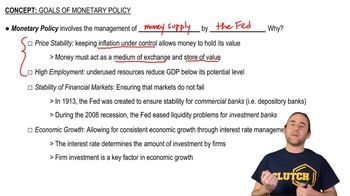
 03:28
03:28