Skip to main content
Microeconomics
나의 코스
배우기
시험 준비
AI 튜터
학습 가이드
플래시카드
탐험해 보세요
앱을 사용해 보세요
나의 코스
배우기
시험 준비
AI 튜터
학습 가이드
플래시카드
탐험해 보세요
앱을 사용해 보세요
뒤로
Marginal Cost definitions
카드를 뒤집기 위해 탭할 수 있습니다.
Marginal Cost
카드를 뒤집기 위해 탭할 수 있습니다.
👆
Marginal Cost
Represents the extra expense from producing one more unit, found by dividing the change in total cost by the change in output.
진행 상황 추적
컨트롤 버튼이 '내비게이션' 모드로 변경되었습니다.
1/14
관련 플래시카드
관련 실천
추천 영상
Marginal Cost quiz #1
Marginal Cost
10 용어
Marginal Cost
10. The Costs of Production
10 문제점
주제
The Relationship Between Average Cost and Marginal Cost
10. The Costs of Production
10 문제점
주제
10. The Costs of Production
9 주제
15 문제점
장
VideoThumbView.guidedCourse
10:48
Marginal Cost
4452
views
53
rank
이 집합의 용어 (14)
하이드의 정의
Marginal Cost
Represents the extra expense from producing one more unit, found by dividing the change in total cost by the change in output.
Total Cost
Sum of all expenses incurred in production, including both fixed and variable components.
Variable Cost
Expense that changes with the level of output, such as wages paid to workers.
Fixed Cost
Expense that remains constant regardless of output, like daily oven rental.
Quantity
Number of units produced, often measured as pizzas in the example.
Marginal Product
Increase in output resulting from adding one more worker, calculated as the change in quantity.
Marginal Cost Curve
Graphical representation showing how extra production costs change as output increases, typically forming a U shape.
Diminishing Returns
Phenomenon where adding more workers leads to smaller increases in output, causing extra costs to rise.
Wage
Payment to workers, treated as a variable cost in production calculations.
Output
Total amount produced, such as the number of pizzas made.
Inverse Relationship
Situation where one variable rises as another falls, seen between marginal product and extra production costs.
U-Shaped Curve
Pattern on a graph where costs decrease initially, then increase sharply, typical for extra production costs.
Change in Total Cost
Difference in overall expenses when output increases, often due to hiring additional workers.
Change in Quantity
Difference in the number of units produced when more resources are added.
 뒤로뒤로
뒤로뒤로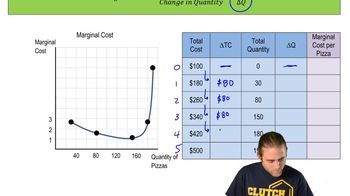
 10:48
10:48