Skip to main content
Microeconomics
나의 코스
배우기
시험 준비
AI 튜터
학습 가이드
플래시카드
탐험해 보세요
앱을 사용해 보세요
나의 코스
배우기
시험 준비
AI 튜터
학습 가이드
플래시카드
탐험해 보세요
앱을 사용해 보세요
뒤로
Price Discrimination quiz #1
카드를 뒤집기 위해 탭할 수 있습니다.
Why do monopolists engage in price discrimination?
카드를 뒤집기 위해 탭할 수 있습니다.
👆
Why do monopolists engage in price discrimination?
Monopolists engage in price discrimination to increase profits by charging different prices to customers based on their willingness to pay.
진행 상황 추적
컨트롤 버튼이 '내비게이션' 모드로 변경되었습니다.
1/37
관련 플래시카드
관련 실천
추천 영상
Price Discrimination definitions
Price Discrimination
15 용어
Price Discrimination
12. Monopoly
10 문제점
주제
Antitrust Laws and Government Regulation of Monopolies
12. Monopoly
10 문제점
주제
12. Monopoly
9 주제
13 문제점
장
VideoThumbView.guidedCourse
04:05
Price Discrimination
1860
views
15
rank
VideoThumbView.guidedCourse
06:11
Perfect Price Discrimination
2208
views
26
rank
VideoThumbView.guidedCourse
07:45
Price Discrimination
2923
views
27
rank
이 집합의 용어 (37)
하이드의 정의
Why do monopolists engage in price discrimination?
Monopolists engage in price discrimination to increase profits by charging different prices to customers based on their willingness to pay.
What are the necessary conditions for price discrimination?
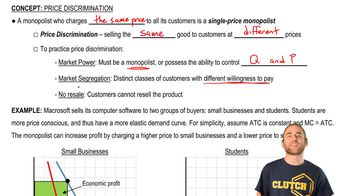
The firm must have market power, be able to segregate the market into distinct groups, and prevent resale of the product.
Who usually benefits from price discrimination?
The monopolist usually benefits from price discrimination by earning higher profits; some consumers may benefit if they pay lower prices.
What is true for a monopolist that engages in perfect price discrimination?
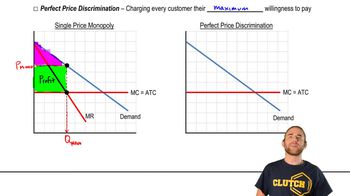
The monopolist captures all consumer surplus and eliminates deadweight loss, producing at the efficient quantity.
What is a necessary condition for price discrimination?
The ability to prevent resale of the product.
What is a result of perfect price discrimination?
Consumer surplus is eliminated and all surplus becomes profit for the monopolist.
Which would definitely not be an example of price discrimination?
Charging all customers the same price for a product regardless of their willingness to pay.
Which term is not associated with price discrimination in the global marketplace?
Uniform pricing.
Under what conditions will monopolies price discriminate?
They have market power, can segment the market, and can prevent resale.
Which case below best represents a case of third-degree price discrimination?
A movie theater charging different prices to adults and children.
How do firms price-discriminate based on elasticity of demand?
Charging different prices to different groups based on elasticity of demand, such as student discounts or senior pricing.
What is a true statement about price discrimination?
Price discrimination allows firms to increase profits by charging different prices to different customers.
What is a result of perfect price discrimination?
Deadweight loss is eliminated and the monopolist produces the efficient quantity.
What is an example of a price-discriminating monopoly?
A software company charging higher prices to businesses and lower prices to students for the same product.
A firm with market power engages in price discrimination in order to
Increase its profits by capturing more consumer surplus.
A monopolist's profits with price discrimination will be
Higher than without price discrimination, as more consumer surplus is captured.
If a monopolist is able to perfectly price discriminate, what happens to consumer surplus?
Consumer surplus is eliminated; all surplus becomes profit for the monopolist.
If a monopolist is able to perfectly price discriminate, what happens to deadweight loss?
Deadweight loss is eliminated, and the monopolist produces the efficient quantity.
A monopolist that practices perfect price discrimination
Charges each customer their maximum willingness to pay and produces the efficient quantity.
A price-discriminating monopolist can increase profits by
Segmenting the market and charging different prices based on customers' willingness to pay.
A perfectly price-discriminating monopolist
Captures all consumer surplus and eliminates deadweight loss.
Price discrimination adds to social welfare in the form of
Eliminating deadweight loss when perfect price discrimination occurs, increasing total surplus.
What are the requirements for price discrimination to occur?
Price discrimination requires market power, market segmentation, and prevention of resale.
What is an example that is not price discrimination?
Selling the same product at the same price to all customers.
What type of firm is able to price-discriminate most successfully?
A firm with strong market power and the ability to prevent resale, such as a software company with license keys.
The term perfect price discrimination means charging
Each customer their maximum willingness to pay.
Price discrimination is only possible when _______.
The firm has market power, can segment the market, and can prevent resale.
Price discrimination works best when
The firm can accurately identify customers' willingness to pay and prevent resale.
A firm cannot price discriminate if
Customers can easily resell the product to others.
If a firm engages in perfect price discrimination, it charges
Each customer the highest price they are willing to pay.
What is an example of a captive pricing strategy?
Selling a printer at a low price but charging high prices for replacement ink cartridges.
If a firm sells the same product to different buyers at different prices, it may be considered
Engaging in price discrimination.
Grouping two or more products together and pricing them as a unit is called
Bundling.
Price discrimination is a rational strategy for a profit-maximizing monopolist when
Different customers have different willingness to pay and resale can be prevented.
What is an example of price discrimination?
A movie theater charging lower prices to students than to adults for the same ticket.
When a pure monopoly practices first-degree price discrimination:
It charges each customer their maximum willingness to pay, capturing all consumer surplus.
Third-degree price discrimination charges different prices to different consumers in order to:
Reflect differences in elasticity of demand among consumer groups and increase profits.
 뒤로
뒤로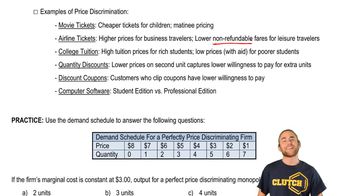
 04:05
04:05