 뒤로
뒤로Microeconomics Core Concepts and Models
 01:42
01:42

이 집합의 용어 (24)
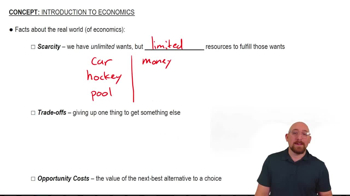
Economics studies incentives and how they influence choices made by individuals, groups, and societies under scarcity.
An economic agent is any individual or group making choices, such as consumers, firms, or politicians.
Optimization, Equilibrium, and Empiricism are the foundational principles guiding economic analysis.
Choosing the best available option given limited resources, involving trade-offs and budget constraints.
The value of the next-best alternative forgone when making a choice.
A state where no individual can improve their outcome by changing behavior unilaterally; all agents are optimizing.
Externalities and the free rider problem can cause equilibrium to be socially suboptimal.
Using data and statistical methods to test economic theories and distinguish correlation from causation.
Positive economics describes what is; normative economics prescribes what ought to be.
Microeconomics studies individual agents and markets; macroeconomics studies the economy as a whole.
A simplified description of reality used to explain and predict economic phenomena.
Correlation means variables move together; causation means one variable directly affects another.
1. Total Value: net benefit = total benefit – total cost.
2. Marginal Analysis: compare marginal benefit and marginal cost.
Many buyers and sellers, identical goods, and no single agent can influence the market price.
As price falls, quantity demanded generally rises, ceteris paribus.
Movement along curve: change in own price.
Shift of curve: change in non-price factors like income or preferences.
As price rises, quantity supplied generally rises, ceteris paribus.
The price and quantity where quantity demanded equals quantity supplied.
For two goods, \(p_j j + p_s s = I\), where p is price, j and s are quantities, and I is income.
Optimal consumption where marginal benefit per dollar is equal across goods: \(\frac{MB_j}{p_j} = \frac{MB_s}{p_s}\).
The difference between what a consumer is willing to pay and what they actually pay, measured as area under demand curve above price.
Greater than 1 = Elastic
Less than 1 = InElastic
Equals 1 = Unit Elastic
\(\text{Elasticity} = \frac{\% \Delta Q_d}{\% \Delta P}\).
Positive = Subsitute
Negative = Complements
Zero = Unrelated
\(\frac{\%\Delta Q_{d}x}{\%\Delta Py}\)
\(\frac{\Delta Q_{}}{\frac{Q1+Q2}{2}}\)
Positive and greater than 1 = normal goods, Luxury
Positive but less than 1 = Normal Good, necessity
Negative = inferior goods.
\(\frac{\%\Delta Q_{d}}{\%\Delta I}\)
\(\frac{\Delta Q_{}}{\frac{Q1+Q2}{2}}\)