 뒤로
뒤로Microeconomics: Demand Concepts and Changes
 06:02
06:02
이 집합의 용어 (19)
Demand is the relationship between the price of a product and the quantity demanded of the product, all else held constant.
A change in price causes a change in quantity demanded, represented by movement along a given demand curve, with no change in demand itself.
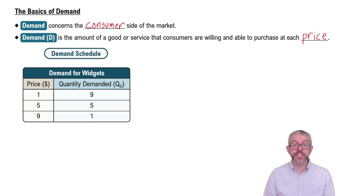
A demand schedule shows the quantity demanded (Qd) at different prices (P), illustrating the inverse relationship between price and quantity demanded.
An increase in income (I) causes an increase in demand for normal goods.
An increase in income (I) causes a decrease in demand for inferior goods.
An increase in the price of a substitute good (\(P_s\)) causes an increase in demand for the product.
An increase in the price of a complement good (\(P_c\)) causes a decrease in demand for the product.
Changes in income, prices of substitutes and complements, tastes, expectations, and other factors can cause the demand curve to shift.
As price decreases from 9 to 5, quantity demanded increases from 13 to 25, showing the inverse relationship between price and quantity demanded.
A movement along the demand curve represents a change in quantity demanded due to a change in the product's price.
A shift of the demand curve represents a change in demand caused by factors other than the product's price.
Demand depends on what expectations about the future are; positive expectations can increase demand, negative expectations can decrease it.
Changes in tastes or preferences can increase or decrease demand depending on whether the product becomes more or less popular.
The demand curve slopes downward, showing that as price decreases, quantity demanded increases, and vice versa.
\(Q_d\) represents the quantity demanded of a product at a given price.
\(P\) represents the price of the product.
An increase in price causes a decrease in quantity demanded, moving upward along the demand curve.
A decrease in price causes an increase in quantity demanded, moving downward along the demand curve.
A change in demand shifts the entire demand curve, while a change in quantity demanded is movement along the same demand curve due to price changes.