 뒤로
뒤로Microeconomics: Demand, Supply, and Production Basics
 06:02
06:02
이 집합의 용어 (20)
Scarcity is our inability to have everything we want due to limited resources.
Microeconomics studies the choices individuals and businesses make, market interactions, and government influence on prices and markets.
Capital earns interest, enterprise earns profit, land earns rent, and labor earns wages.
Opportunity cost is the highest-valued alternative given up to get something, also called the best alternative forgone.
Marginal benefit is the gain from an incremental increase in activity; marginal cost is the opportunity cost of that increase.
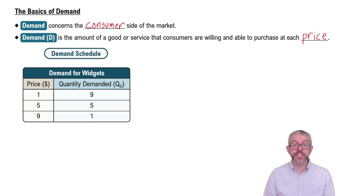
Other things equal, as price rises, quantity demanded falls; as price falls, quantity demanded rises.
Substitution effect and income effect cause the demand curve to slope downward.
A change in quantity demanded is due to price changes only; a change in demand is caused by factors other than price.
Normal goods: demand increases as income rises. Inferior goods: demand decreases as income rises.
Allocative efficiency occurs when production maximizes value, producing the preferred combination of goods where marginal cost equals marginal benefit.
The PPF is the boundary showing all efficient combinations of goods that can be produced with available resources.
A point inside the PPF is attainable but inefficient, meaning resources are underutilized.
Comparative advantage is the ability to produce a good at a lower opportunity cost than others.
Absolute advantage is being more productive than others in producing a good.
Prices of related goods, expected future prices, income, expected future income and credit, population, and preferences.
When a good's price rises, consumers switch to cheaper substitutes, reducing quantity demanded of the original good.
When prices rise and income stays the same, consumers can afford less, reducing quantity demanded.
A market with many buyers and sellers where no single participant can influence the price.
Money price is the dollar amount for a good; relative price is the ratio of one good's price to another's, representing opportunity cost.
The more of a good we have, the smaller the marginal benefit and willingness to pay for an additional unit.