 뒤로
뒤로Microeconomics: Economic Efficiency, Price Controls, Taxes, and Surpluses
 07:07
07:07
이 집합의 용어 (20)
Occurs when quantity supplied equals quantity demanded, and the supply and demand curves intersect.
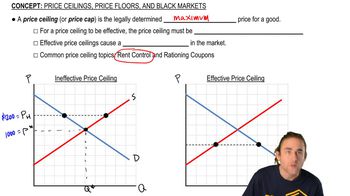
A legally determined maximum price sellers can charge, binding only if set below equilibrium price, causing shortages.
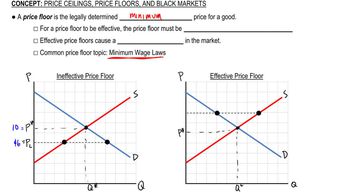
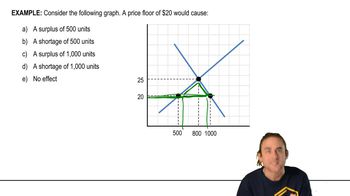
A legally determined minimum price sellers can receive, binding only if set above equilibrium price, causing surpluses.
The difference between the highest price consumers are willing to pay and the price they actually pay; area below demand curve and above price.
The difference between the lowest price producers are willing to accept and the price they actually receive; area above supply curve and below price.
The sum of consumer surplus and producer surplus; maximized at market equilibrium.
The additional benefit a consumer receives from consuming one more unit of a good or service; represented by the demand curve.
The additional cost to a firm of producing one more unit of a good or service; represented by the supply curve.
The loss in economic surplus due to market inefficiency caused by price controls or taxes; surplus that disappears.
A market where buying and selling occur at prices violating government price regulations.
A price ceiling set below equilibrium price that prevents price from rising, causing shortages.
A price floor set above equilibrium price that prevents price from falling, causing surpluses.
Increases consumer surplus for some but causes shortages and reduces producer surplus, lowering economic efficiency.
Increases producer surplus for some but causes surpluses and reduces consumer surplus, lowering economic efficiency.
The division of the burden of a tax between buyers and sellers, depending on supply and demand elasticity.
Taxes reduce quantity produced and consumed, create deadweight loss, and generate tax revenue for the government.
Set quantity demanded equal to quantity supplied and solve for price and quantity.
Area of triangle below demand curve and above price line: \(\frac{1}{2} \times base \times height\).
Area of triangle above supply curve and below price line, adjusted for supply curve intercept.
Achieved when marginal benefit equals marginal cost at market equilibrium, maximizing total surplus.