 뒤로
뒤로Microeconomics Key Concepts: Chapters 1-6
 01:42
01:42

이 집합의 용어 (23)
Microeconomics studies individual economic units like consumers and firms, focusing on decision-making and resource allocation.
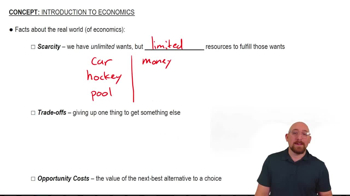
Opportunity cost is the value of the next best alternative foregone when making a choice.
The PPF shows the maximum combinations of two goods that can be produced with available resources and technology.
A change in the price of the good causes a movement along the demand curve.
Changes in income, tastes, prices of related goods, expectations, and number of buyers shift the demand curve.
Price elasticity of demand measures how much quantity demanded responds to a change in price.
The law of supply states that quantity supplied rises as price rises, ceteris paribus.
Input prices, technology, expectations, number of sellers, and taxes/subsidies shift the supply curve.
Market equilibrium occurs where quantity demanded equals quantity supplied at the equilibrium price.
A price ceiling below equilibrium causes a shortage as quantity demanded exceeds quantity supplied.
A price floor above equilibrium causes a surplus because quantity supplied exceeds quantity demanded.
Consumer surplus is the difference between what consumers are willing to pay and what they actually pay.
Producer surplus is the difference between the price producers receive and their minimum acceptable price.
Incentives influence behavior by encouraging or discouraging certain actions.
Marginal analysis examines the additional benefits and costs of a decision.
Normal goods see demand increase with income; inferior goods see demand decrease as income rises.
An increase in the price of one good increases demand for its substitute.
A price increase in one good decreases demand for its complement.
Price elasticity of demand = \(\frac{\%\text{ change in quantity demanded}}{\%\text{ change in price}}\)
Elastic demand means quantity demanded changes more than price changes (elasticity > 1).
Inelastic demand means quantity demanded changes less than price changes (elasticity < 1).
A tax shifts the supply curve left, increasing price and reducing quantity sold.
Deadweight loss is the loss of total surplus due to market inefficiency like taxes or price controls.