 뒤로
뒤로Microeconomics Key Concepts
 01:42
01:42

이 집합의 용어 (20)
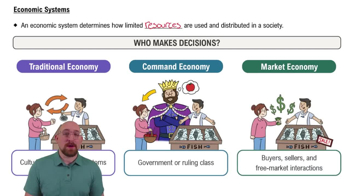
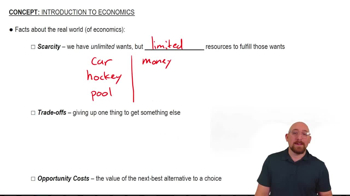
Economics is the study of how individuals and societies allocate scarce resources to satisfy unlimited wants.
What to produce? How to produce? For whom to produce?
It involves considering opportunity costs, marginal analysis, and incentives to make rational decisions.
A curve showing the maximum attainable combinations of two goods that can be produced with available resources and technology.
Moving along the PPF shows the opportunity cost of producing more of one good in terms of the other good forgone.
Opportunity cost is the value of the next best alternative foregone when making a choice.
Marginal cost is the additional cost of producing one more unit of a good.
Efficient resource use maximizes output and avoids waste, allowing the economy to produce on the PPF.
Economic growth shifts the PPF outward due to increased resources or improved technology.
Demand is the quantity of a good consumers are willing and able to buy at different prices.
Supply is the quantity of a good producers are willing and able to sell at different prices.
Market equilibrium occurs where quantity demanded equals quantity supplied, determining the market price.
Shifts in demand or supply curves change equilibrium price and quantity.
Graphs visually represent relationships like demand, supply, and PPF to analyze economic behavior.
Mathematical notes help calculate opportunity cost, marginal cost, and predict changes in price and quantity.
Marginal cost reflects the opportunity cost of producing one additional unit of a good.
An increase in an economy's capacity to produce goods, indicating economic growth.
The economy produces inside the PPF, indicating wasted resources or inefficiency.
The rate at which quantity demanded changes as price changes, reflecting consumer responsiveness.
The rate at which quantity supplied changes as price changes, reflecting producer responsiveness.