Skip to main content
Microeconomics
나의 코스
배우기
시험 준비
AI 튜터
학습 가이드
플래시카드
탐험해 보세요
앱을 사용해 보세요
나의 코스
배우기
시험 준비
AI 튜터
학습 가이드
플래시카드
탐험해 보세요
앱을 사용해 보세요
뒤로
Microeconomics: Production Possibilities and Comparative Advantage
카드를 뒤집기 위해 탭할 수 있습니다.
What does the production possibilities curve (PPC) represent?
카드를 뒤집기 위해 탭할 수 있습니다.
👆
What does the production possibilities curve (PPC) represent?
The PPC shows all possible combinations of two goods that can be produced using available resources efficiently.
진행 상황 추적
컨트롤 버튼이 '내비게이션' 모드로 변경되었습니다.
1/20
추천 영상
04:36
Opportunity Costs and Comparative Advantage
185
views
1
rank
02:03
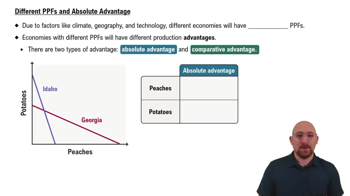
Different PPFs and Absolute Advantage
196
views
6
rank
이 집합의 용어 (20)
하이드의 정의
What does the production possibilities curve (PPC) represent?
The PPC shows all possible combinations of two goods that can be produced using available resources efficiently.
What do points inside, on, and outside the PPC represent?
Points inside are inefficient, points on the curve are efficient, and points outside are unattainable with current resources.
What is the opportunity cost in production?
The opportunity cost is the value of the next best alternative foregone when making a choice.
How is the slope of the PPC interpreted?
The slope measures the opportunity cost of one good in terms of the other good.
Why do opportunity costs exist?
Because resources are limited and producing more of one good requires using resources that could produce another good.
What is the difference between efficient and inefficient production?
Efficient production uses all resources without waste; inefficient production wastes resources or produces less than possible.
What does specialization mean in trade?
Specialization means focusing production on goods where a country has a comparative advantage.
What is comparative advantage?
A country has a comparative advantage if it can produce a good at a lower opportunity cost than another country.
What is absolute advantage?
A country has an absolute advantage if it can produce more of a good with the same resources than another country.
Can a country benefit from trade if it has an absolute advantage in all goods?
Yes, if it has a comparative advantage in producing some goods, trade can still be beneficial.
How do you calculate opportunity cost of cloth in the US example?
Opportunity cost of cloth = units of wheat given up / units of cloth produced; in US, 1 unit cloth costs 2 units wheat.
How do you calculate opportunity cost of wheat in the GB example?
Opportunity cost of wheat = units of cloth given up / units of wheat produced; in GB, 1 unit wheat costs 0.5 units cloth.
What happens to global production when countries specialize according to comparative advantage?
Global production increases because each country produces more of the good with lower opportunity cost.
What is the global gain from trade in the cloth and wheat example?
Global gain is the increase in total production of both goods after specialization and trade.
Why might some people oppose free trade despite overall gains?
Because trade can cause job losses or wage reductions in certain industries or groups.
What is the role of opportunity cost in deciding production choices?
Producers should choose to produce goods with the lowest opportunity cost to maximize efficiency.
How does moving resources affect production possibilities?
Moving resources from one good to another changes the production mix and opportunity costs.
What does it mean if a country is 'better' at producing all goods?
It means it has an absolute advantage in all goods, but comparative advantage still determines trade benefits.
What is the significance of the statement: 'It is important to carefully consider the likelihood of job losses'?
Trade benefits must be weighed against potential negative impacts on workers in affected industries.
How do you solve for opportunity cost using production quantities?
Set total resource use equal for both goods and solve for one good in terms of the other.
 뒤로뒤로
뒤로뒤로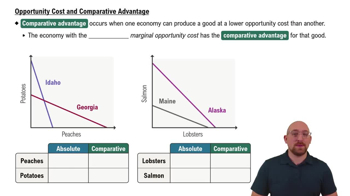
 04:36
04:36