 뒤로
뒤로Microeconomics: Production Possibilities Frontier and Opportunity Cost
 06:23
06:23
이 집합의 용어 (23)
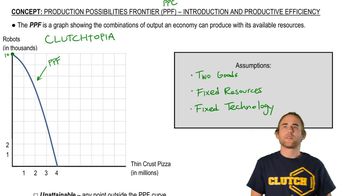
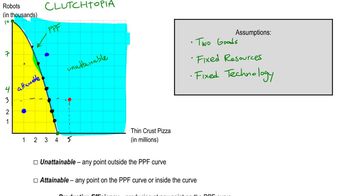
The boundary between combinations of goods and services that can be produced and those that cannot, holding everything else constant.
Attainable and efficient in production; represent maximum output combinations.
Unattainable with current resources, illustrating scarcity.
Attainable but inefficient; resources are underutilized.
The amount of one good that must be sacrificed to produce more of another good; calculated as \(\frac{\Delta Y}{\Delta X}\).
Indicates increasing opportunity cost; producing more of one good costs increasingly more of the other.
Indicates constant opportunity cost; tradeoff between goods is constant.
When we cannot produce more of one good without producing less of another; any point on the PPF.
When we cannot produce more of any good without giving up something we value more highly; occurs where marginal benefit equals marginal cost (MB = MC).
The opportunity cost of producing one more unit of a good; generally rises as production increases.
The benefit from consuming one more unit of a good, measured by willingness to pay; decreases as quantity consumed increases.
The more of a good we have, the smaller the marginal benefit and the less we are willing to pay for an additional unit.
The outward shift of the PPF, representing an increase in production possibilities and standard of living.
Technological change and capital accumulation (including human capital).
Less current consumption because resources are used for research, development, and capital formation.
Opportunity cost of good X = amount of good Y given up ÷ extra units of X gained, ignoring the minus sign.
If 1 pizza costs 5 cans of cola, then 1 can of cola costs \(\frac{1}{5}\) pizza.
All points on the PPF are efficient; choosing among them requires comparing costs and benefits.
A description of likes and dislikes, represented by the marginal benefit curve.
Shows the relationship between the marginal benefit of a good and the quantity consumed; downward sloping.
Increasing production of one good requires sacrificing some amount of another good.
Shifts the entire PPF outward, increasing production possibilities for all goods.
Shifts only the intercept of the affected good outward, leaving the other intercept unchanged.