 뒤로
뒤로Ten Principles of Microeconomics
 09:36
09:36
이 집합의 용어 (20)
Scarcity means society has limited resources and cannot produce all the goods and services people wish to have.
Economics studies how society manages scarce resources: how individuals decide what to buy, work, and save; how firms decide what to produce and hire; and how society allocates resources.
1. Face trade-offs
2. Cost is what you give up
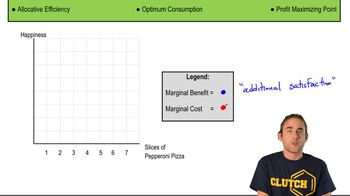
3. Think at margin (MB ≥ MC)
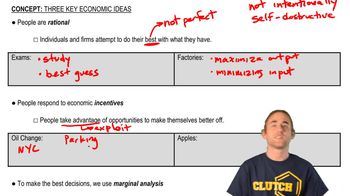
4. Respond to incentives
Efficiency: maximizing total output.
Equality: distributing prosperity uniformly.
Policy trade-off: higher taxes increase equality but reduce incentives and total output.
The opportunity cost of an item is whatever must be given up to obtain it, i.e., the value of the next best alternative foregone.
A rational decision-maker takes an action if and only if \(MB \geq MC\), where MB is marginal benefit and MC is marginal cost.
Sunk costs are past costs that cannot be recovered and should not affect current decisions. Rational people compare only future MB and MC.
Voluntary trade makes both participants better off and expands the total pie of goods and services.
Centrally planned: government decides production and allocation.
Market economy: decentralized decisions by millions of firms and households.
Self-interested buyers and sellers, guided by prices, maximize social welfare without central direction.
Market failure occurs due to externalities (effects on others) or market power (monopoly), leading to inefficient resource allocation.
Governments enforce property rights and can intervene to correct market failures and improve efficiency.
Inflation is caused by rapid growth in the quantity of money, which reduces the value of money.
In the short run, stimulus increases spending, causing demand spikes, hiring rises, and prices rise, creating a trade-off between inflation and unemployment.
Taxing income funds welfare and increases equality but high tax rates reduce incentives to work and invest, shrinking total output.
Waiting 2 hours in line for concert tickets costs cash plus 2 hours of study or sleep, representing the opportunity cost.
Decisions should be made by comparing the additional benefit and additional cost of one more unit.
People respond to incentives because they compare costs and benefits; changes in incentives change behavior.
Specialization allows individuals to do what they do best and trade for the rest, increasing overall efficiency.
Higher productivity means more goods and services per labor unit, explaining most variation in living standards.