Skip to main content
Nutrition
나의 코스
배우기
시험 준비
AI 튜터
학습 가이드
플래시카드
앱을 사용해 보세요
나의 코스
배우기
시험 준비
AI 튜터
학습 가이드
플래시카드
앱을 사용해 보세요
뒤로
Assessing Weight Related Health Risk definitions
카드를 뒤집기 위해 탭할 수 있습니다.
Body Mass Index
카드를 뒤집기 위해 탭할 수 있습니다.
👆
Body Mass Index
A numerical value derived from weight and height, used as a quick, inexpensive indicator of weight-related health risk.
진행 상황 추적
컨트롤 버튼이 '내비게이션' 모드로 변경되었습니다.
1/15
관련 플래시카드
관련 실천
추천 영상
Assessing Weight Related Health Risk quiz
Assessing Weight Related Health Risk
15 용어
Assessing Weight Related Health Risk exam
Assessing Weight Related Health Risk
29 용어
Assessing Weight Related Health Risk quiz #1
Assessing Weight Related Health Risk
10 용어
Assessing Weight Related Health Risk
10. Energy Balance: Body Weight, Obesity, & Eating Disorders
10 문제점
주제
Factors That Influence Weight
10. Energy Balance: Body Weight, Obesity, & Eating Disorders
10 문제점
주제
10. Energy Balance: Body Weight, Obesity, & Eating Disorders
8 주제
15 문제점
장
04:51
Body Composition
224
views
3
rank
06:29
Methods for Measuring Body Composition
203
views
3
rank
03:00
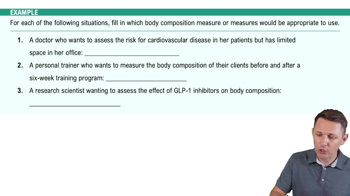
Assessing Weight Related Health Risk Example 2
117
views
1
rank
이 집합의 용어 (15)
하이드의 정의
Body Mass Index
A numerical value derived from weight and height, used as a quick, inexpensive indicator of weight-related health risk.
BMI Categories
Classifications based on BMI values: underweight, healthy weight, overweight, and obese, each linked to different health risks.
Body Composition
The relative proportions of lean mass and fat mass in the body, providing a more accurate health assessment than BMI alone.
Lean Body Mass
All body components except fat, including muscle, bone, organs, and water; often the focus for fitness improvements.
Fat Body Mass
The total amount of adipose tissue in the body, with higher levels linked to increased risk of chronic diseases.
Visceral Fat
Fat stored around internal organs in the torso, strongly associated with central obesity and elevated disease risk.
Subcutaneous Fat
Fat located beneath the skin but above muscle, often referred to as 'pinchable' fat and less risky than visceral fat.
Central Obesity
Excess fat accumulation around the midsection, often linked to higher levels of visceral fat and greater health risks.
Apple Distribution
A body shape characterized by more fat around the abdomen, associated with higher central obesity and disease risk.
Pear Distribution
A body shape with more fat on the hips and thighs, typically linked to lower central obesity and reduced health risk.
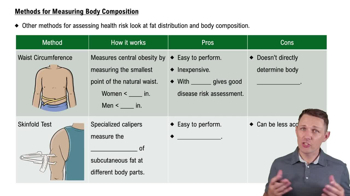
Waist Circumference
A measurement around the smallest part of the waist, used to assess central obesity and related health risks.
Skin Fold Test
A method using calipers to measure the thickness of subcutaneous fat at various body sites to estimate body fat percentage.
Bioelectrical Impedance
A technique that estimates body fat by measuring how easily a low-level electrical current passes through the body.
Underwater Weighing
A method comparing body weight in and out of water to determine body composition based on tissue density differences.
Dual X-ray Absorptiometry
A highly accurate scan using low-level x-rays to differentiate and measure bone, lean tissue, and fat in the body.
 뒤로뒤로
뒤로뒤로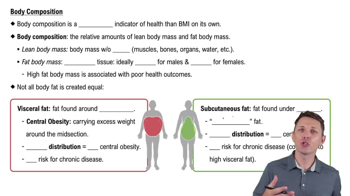
 04:51
04:51