Skip to main content
Nutrition
나의 코스
배우기
시험 준비
AI 튜터
학습 가이드
플래시카드
앱을 사용해 보세요
나의 코스
배우기
시험 준비
AI 튜터
학습 가이드
플래시카드
앱을 사용해 보세요
뒤로
Dietary Reference Intakes exam
카드를 뒤집기 위해 탭할 수 있습니다.
What does DRI stand for?
카드를 뒤집기 위해 탭할 수 있습니다.
👆
What does DRI stand for?
Dietary Reference Intakes
진행 상황 추적
컨트롤 버튼이 '내비게이션' 모드로 변경되었습니다.
1/30
관련 플래시카드
관련 실천
추천 영상
Dietary Reference Intakes definitions
Dietary Reference Intakes
13 용어
Dietary Reference Intakes quiz
Dietary Reference Intakes
15 용어
Dietary Reference Intakes quiz #1
Dietary Reference Intakes
10 용어
Dietary Reference Intakes
2. Tools for Healthful Eating
10 문제점
주제
2. Tools for Healthful Eating
4 주제
15 문제점
장
02:29
Dietary Reference Intakes Example 1
374
views
7
rank
03:45
Dietary Reference Intakes Example 2
344
views
6
rank
03:59
Dietary Reference Intakes Example 3
342
views
6
rank
이 집합의 용어 (30)
하이드의 정의
What does DRI stand for?
Dietary Reference Intakes
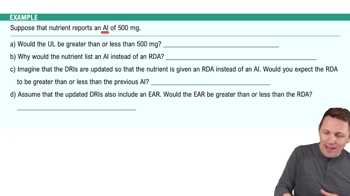
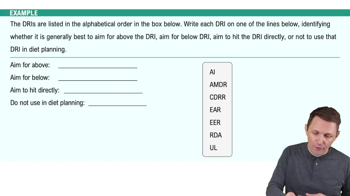
Recommended Dietary Allowance (RDA)
The amount of a nutrient that meets the needs of 97-98% of healthy individuals.
Who establishes the DRIs?
The National Academy of Sciences.
Adequate Intake (AI)
An estimated amount assumed to be sufficient when there is not enough evidence to set an RDA.
What is the purpose of DRIs?
To provide guidelines for nutrient and energy consumption for optimal health.
Tolerable Upper Intake Level (UL)
The highest daily intake of a nutrient that is unlikely to pose health risks.
Estimated Average Requirement (EAR)
The amount of a nutrient that meets the needs of 50% of individuals in a group.
For whom are DRIs intended?
Healthy individuals.
Chronic Disease Risk Reduction Intake (CDRR)
A DRI value set for nutrients related to chronic disease risk, such as sodium and hypertension.
What does the EER estimate?
The typical number of calories needed for an individual per day.
Acceptable Macronutrient Distribution Range (AMDR)
The recommended percentage of calories from carbohydrates, fats, and proteins to minimize chronic disease risk.
What factors are considered in EER calculations?
Age, sex, height, weight, and activity level.
Why might an AI be set instead of an RDA?
Because there is not enough scientific evidence to determine an exact RDA.
What is the AMDR for carbohydrates?
45-65% of total daily calories.
What is the AMDR for fat?
20-35% of total daily calories.
What is the AMDR for protein?
10-35% of total daily calories.
How are DRIs applied over time?
They are meant to be met on average over several days, not necessarily every day.
What is the main use of the EAR?
For research and policy, not for individual recommendations.
What happens if intake exceeds the UL?
There is an increased risk of toxicity or adverse health effects.
What is the CDRR for sodium?
2,300 mg per day to reduce risk of hypertension.
Do DRIs vary by population?
Yes, they differ by age, sex, pregnancy, and lactation status.
What does the RDA represent on the nutrient adequacy scale?
The lower end of the adequacy range, covering almost all healthy individuals.
Why is the EER considered an estimate?
Because individual calorie needs vary due to genetics and metabolism.
What is the main goal of the AMDR?
To minimize the risk of chronic diseases by balancing macronutrient intake.
What is the difference between RDA and AI?
RDA is based on strong evidence for 97-98% of people; AI is set when evidence is insufficient for an RDA.
What is the deficiency range?
A level of nutrient intake below adequacy, increasing risk of deficiency symptoms.
What is the toxicity range?
A level of nutrient intake above the UL, increasing risk of adverse effects.
How are DRIs presented?
As specific tables with values for each nutrient and population group.
What is the main difference between DRIs for nutrients and for energy/macronutrients?
Nutrient DRIs are minimums or maximums; energy/macronutrient DRIs are targets or ranges.
What is the purpose of the UL?
To indicate the maximum safe intake level for a nutrient.
 뒤로뒤로
뒤로뒤로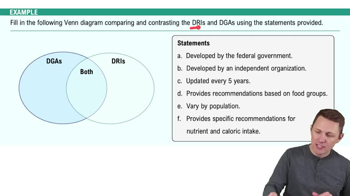
 02:29
02:29