Skip to main content
Nutrition
나의 코스
배우기
시험 준비
AI 튜터
학습 가이드
플래시카드
앱을 사용해 보세요
나의 코스
배우기
시험 준비
AI 튜터
학습 가이드
플래시카드
앱을 사용해 보세요
뒤로
Introduction to Vitamins exam
카드를 뒤집기 위해 탭할 수 있습니다.
What are vitamins?
카드를 뒤집기 위해 탭할 수 있습니다.
👆
What are vitamins?
Essential organic micronutrients required in small amounts for health.
진행 상황 추적
컨트롤 버튼이 '내비게이션' 모드로 변경되었습니다.
1/29
관련 플래시카드
관련 실천
추천 영상
Introduction to Vitamins definitions
Introduction to Vitamins
15 용어
Introduction to Vitamins quiz
Introduction to Vitamins
15 용어
Introduction to Vitamins quiz #1
Introduction to Vitamins
10 용어
Introduction to Vitamins
7. Vitamins
10 문제점
주제
Fat-Soluble Vitamins
7. Vitamins
10 문제점
주제
7. Vitamins
5 주제
15 문제점
장
VideoThumbView.guidedCourse
05:25
What are Vitamins?
470
views
13
rank
VideoThumbView.guidedCourse
01:32
Antioxidants
287
views
4
rank
VideoThumbView.guidedCourse
03:29
Introduction to Vitamins Example 1
221
views
3
rank
이 집합의 용어 (29)
하이드의 정의
What are vitamins?
Essential organic micronutrients required in small amounts for health.
Micronutrients
Nutrients needed in small amounts, including vitamins and minerals.
How are vitamins different from minerals?
Vitamins are organic (carbon-based); minerals are inorganic.
Fat-soluble vitamins
Vitamins A, D, E, and K that dissolve in fat and are stored in body tissues.
How many essential vitamins are there?
There are 13 essential vitamins needed by the human body.
Water-soluble vitamins
B vitamins (8 types) and vitamin C, which dissolve in water and are not stored extensively.
Are vitamins a source of calories?
No, vitamins are non-caloric and do not provide energy.
Provitamin
An inactive precursor that must be converted to an active vitamin form in the body.
Preformed vitamin
A vitamin in its active, usable form as found in food.
What is bioavailability?
The percentage of a consumed vitamin that is absorbed and available for use in the body.
Which sources are typically less bioavailable: plant or animal?
Plant-based vitamin sources are generally less bioavailable than animal-based sources.
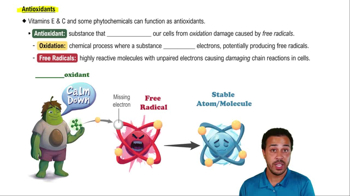
Antioxidant
A substance that protects cells from damage by free radicals.
Which vitamins act as antioxidants?
Vitamins E and C function as antioxidants.
Free radical
A highly reactive molecule with unpaired electrons that can damage cells.
What is oxidation in the context of vitamins?
A chemical process where a substance loses electrons, potentially creating free radicals.
Why are some vitamin letters and numbers missing?
Some were reclassified as not vitamins, and their designations were retired.
How are vitamin names (letters/numbers) assigned?
Based on the order of their discovery.
Are all vitamins single molecules?
No, most vitamins are groups of related molecules with the same function, except B7 and C.
What is the main function of vitamins in the body?
To support various biological processes and maintain health.
Why is vitamin D considered essential even though the body can synthesize it?
Because the body usually does not make enough, so dietary intake is needed.
What is a provitamin example?
Beta carotene is a provitamin that is converted to vitamin A.
Which vitamin is found in egg yolk in its preformed state?
Vitamin A (as retinol).
What does 'non-caloric' mean?
Does not provide calories or energy.
Which vitamins are only required in small amounts?
Micronutrients, including all vitamins.
What is the function of antioxidants like vitamin E?
They donate electrons to free radicals, stabilizing them and preventing cell damage.
Which vitamin group includes thiamine?
B vitamins (specifically, vitamin B1).
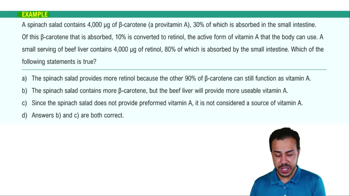
What is the bioavailability of beta carotene from spinach salad?
About 30%.
What is the bioavailability of retinol from liver?
About 80%.
Why are vitamins defined more by function than structure?
Because most represent groups of molecules with the same biological function.
 뒤로뒤로
뒤로뒤로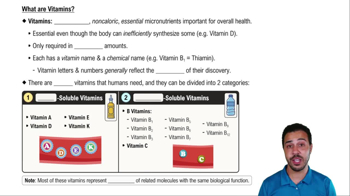
 05:25
05:25