Skip to main content
Nutrition
나의 코스
배우기
시험 준비
AI 튜터
학습 가이드
플래시카드
앱을 사용해 보세요
나의 코스
배우기
시험 준비
AI 튜터
학습 가이드
플래시카드
앱을 사용해 보세요
뒤로
Macronutrients exam
카드를 뒤집기 위해 탭할 수 있습니다.
What are the three classes of macronutrients?
카드를 뒤집기 위해 탭할 수 있습니다.
👆
What are the three classes of macronutrients?
Carbohydrates, lipids (fats), and proteins.
진행 상황 추적
컨트롤 버튼이 '내비게이션' 모드로 변경되었습니다.
1/29
관련 플래시카드
관련 실천
추천 영상
Macronutrients definitions
Macronutrients
14 용어
Macronutrients quiz
Macronutrients
15 용어
Macronutrients quiz #1
Macronutrients
10 용어
Macronutrients
1. Science of Nutrition
10 문제점
주제
Micronutrients
1. Science of Nutrition
10 문제점
주제
1. Science of Nutrition
8 주제
15 문제점
장
02:38
Macronutrients Example 1
634
views
19
rank
06:10
Carbohydrates, Lipids, & Protein
931
views
29
rank
이 집합의 용어 (29)
하이드의 정의
What are the three classes of macronutrients?
Carbohydrates, lipids (fats), and proteins.
Carbohydrates
Macronutrients made of carbon, hydrogen, and oxygen; primary energy source for the body.
What elements make up carbohydrates?
Carbon, hydrogen, and oxygen.
Lipids
A group of macronutrients, mainly fats, used for energy storage and low-intensity exercise.
What is the main function of carbohydrates in the body?
They serve as the body's preferred energy source.
Proteins
Macronutrients made of amino acids, containing carbon, hydrogen, oxygen, and nitrogen; essential for tissue building and repair.
What are the building blocks of proteins?
Amino acids.
What additional element is found in proteins but not in carbohydrates or lipids?
Nitrogen.
What is a triglyceride?
A molecule made of three fatty acids attached to a glycerol backbone; main form of fat in the diet.
Where are carbohydrates primarily found?
In plant foods such as whole grains, fruits, and vegetables.
What is the difference between fats and oils?
Fats are solid at room temperature (usually from animals), while oils are liquid (usually from plants).
What happens to carbohydrates during digestion?
They are broken down into simple sugars like glucose.
What is the main function of lipids in the body?
Energy storage and providing energy during low-intensity exercise.
What is the preferred energy source for low-intensity exercise?
Lipids (fats).
What are the main dietary sources of protein?
Meat, dairy, nuts, seeds, and legumes.
What is the main function of proteins in the body?
Building and repairing tissues; can also be used for energy.
What are fatty acids?
Long chains of carbon and hydrogen that make up fats.
What is the chemical composition of lipids?
Carbon, hydrogen, and oxygen.
What is the main form in which energy is stored in the body?
As fat in fat cells (adipose tissue).
What is a simple sugar?
A basic carbohydrate unit, such as glucose.
What is the role of amino acids after protein digestion?
They are absorbed and used to build new proteins in the body.
What is the main source of carbohydrates in the diet?
Plants.
What makes fats insoluble in water?
Their long chains of carbon and hydrogen.
What is a macronutrient?
A nutrient required in large amounts for energy and bodily functions.
What is the difference between simple and complex carbohydrates?
Simple carbohydrates are single or double sugar units; complex carbohydrates are long chains of sugars.
What is the main function of dietary fat?
Long-term energy storage and insulation.
What is a common plant source of protein?
Legumes (such as beans).
What is the main function of carbohydrates during exercise?
To provide quick energy for muscle activity.
What is the significance of the side chain in amino acids?
It differentiates each amino acid and determines its properties.
 뒤로뒤로
뒤로뒤로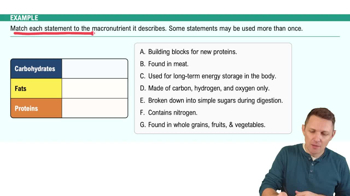
 02:38
02:38