Skip to main content
Nutrition
나의 코스
배우기
시험 준비
AI 튜터
학습 가이드
플래시카드
앱을 사용해 보세요
나의 코스
배우기
시험 준비
AI 튜터
학습 가이드
플래시카드
앱을 사용해 보세요
뒤로
Nutrition as a Science exam
카드를 뒤집기 위해 탭할 수 있습니다.
What is the first step in the scientific method as applied to nutrition research?
카드를 뒤집기 위해 탭할 수 있습니다.
👆
What is the first step in the scientific method as applied to nutrition research?
Making observations or asking questions about a phenomenon.
진행 상황 추적
컨트롤 버튼이 '내비게이션' 모드로 변경되었습니다.
1/29
관련 플래시카드
관련 실천
추천 영상
Nutrition as a Science definitions
Nutrition as a Science
16 용어
Nutrition as a Science quiz
Nutrition as a Science
15 용어
Nutrition as a Science
1. Science of Nutrition
10 문제점
주제
Finding Credible Nutrition Information
1. Science of Nutrition
10 문제점
주제
1. Science of Nutrition
8 주제
15 문제점
장
04:30
Laboratory and Observational Studies
427
views
14
rank
03:57
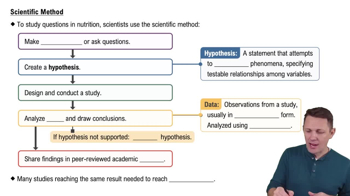
Scientific Method
533
views
12
rank
04:27
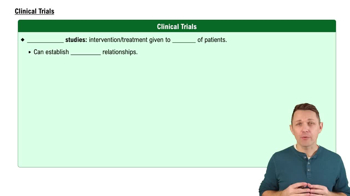
Clinical Trials
431
views
8
rank
이 집합의 용어 (29)
하이드의 정의
What is the first step in the scientific method as applied to nutrition research?
Making observations or asking questions about a phenomenon.
Hypothesis
A statement that attempts to predict phenomena by specifying testable relationships among variables.
What is the gold standard for establishing causal relationships in nutrition research?
Randomized, double-blind, placebo-controlled clinical trials.
Clinical Trial
A controlled study where an intervention is given to some participants to establish causal relationships.
Why are clinical trials considered highly trustworthy?
Because they are controlled, randomized, and can establish causality.
Experimental Group
The group in a clinical trial that receives the treatment or intervention.
Control Group
The group in a clinical trial that does not receive the treatment, often receiving a placebo.
Placebo
A treatment with no therapeutic effect, used to control for participants' expectations.
What is a single-blind study?
A study in which participants do not know whether they are in the experimental or control group.
Double-Blind Study
A study in which neither the participants nor the researchers know who is in the experimental or control group.
Why is randomization important in clinical trials?
It prevents selection bias and ensures groups are comparable.
Laboratory Study
A highly controlled experiment, often on animals, to test hypotheses before human trials.
Why should laboratory studies on animals be followed up in humans?
Because results in animals may not always apply to humans.
Observational Study
A study where researchers observe individuals without intervening, showing correlations but not causation.
Case Study
A report on a particular individual, often used to highlight interesting or unusual findings.
Case-Control Study
A study comparing a group with a condition to a group without it to find correlations.
Epidemiological Study
A large-scale observational study on defined populations, often over many years, to find correlations.
What is the main limitation of observational studies in nutrition?
They can show correlations but cannot establish causation.
Peer Review
The process where other scientists evaluate a study before publication to ensure scientific rigor.
Why must nutritional findings be replicated?
To ensure accuracy and reliability before forming dietary recommendations.
What happens if a hypothesis is not supported by data?
The hypothesis is refined and the study process is repeated.
Correlation vs. Causation
Correlation is an association between variables; causation means one variable directly affects another.
Why does nutritional advice sometimes change over time?
Because new, more controlled studies may reveal that previous correlations were not causal.
What is the role of statistics in nutrition research?
To analyze numerical data and draw valid conclusions from studies.
Replication
Repeating studies to confirm findings and build scientific consensus.
What is a consensus in nutrition science?
Agreement among multiple studies with similar results, forming the basis for recommendations.
Why aren't all nutrition studies randomized, double-blind, placebo-controlled trials?
Because they are complex, expensive, and not always practical for preliminary research.
What is the purpose of a control group receiving a placebo?
To ensure that any effects observed are due to the treatment, not participants' expectations.
What is the final step in the scientific method?
Sharing findings, ideally in a peer-reviewed academic journal.
 뒤로뒤로
뒤로뒤로
 04:30
04:30