Skip to main content
Nutrition
나의 코스
배우기
시험 준비
AI 튜터
학습 가이드
플래시카드
앱을 사용해 보세요
나의 코스
배우기
시험 준비
AI 튜터
학습 가이드
플래시카드
앱을 사용해 보세요
뒤로
NFS CH 6
카드를 뒤집기 위해 탭할 수 있습니다.
Primary purpose of heating foods in food safety
카드를 뒤집기 위해 탭할 수 있습니다.
👆
Primary purpose of heating foods in food safety
To kill harmful microorganisms and make food safe to eat.
진행 상황 추적
컨트롤 버튼이 '내비게이션' 모드로 변경되었습니다.
1/31
추천 영상
04:52
Introduction to Food Safety
152
views
02:43
Food Safety Example 1
104
views
01:59
Food Safety Example 2
88
views
2
rank
이 집합의 용어 (31)
하이드의 정의
Primary purpose of heating foods in food safety
To kill harmful microorganisms and make food safe to eat.
Three ways heating alters foods
Changes texture, flavor, and color.
Definition of moist-heat preparation
Cooking food with water or steam, such as boiling or steaming.
One potential drawback of moist-heat preparation
Can cause loss of nutrients and flavor into the cooking water.
Three moist-heat preparation methods
Boiling, steaming, and poaching.
Definition of dry-heat preparation
Cooking food without water, using air or fat to transfer heat.
Maximum temperature in dry-heat vs moist-heat preparation
Dry-heat can reach higher temperatures than moist-heat methods.
Four types of heat transfer in cooking
Conduction, convection, radiation, and induction.
Definition of conduction with example
Heat transfer through direct contact; example: frying in a pan.
Definition of convection with two examples
Heat transfer through fluid movement; examples: boiling and baking.
Definition of radiation with example
Heat transfer through electromagnetic waves; example: grilling.
Definition of induction and how it works
Heat generated by magnetic fields in cookware; heats pots directly.
Three main scales to measure heat
Celsius, Fahrenheit, and Kelvin.
Kinetic energy in heating foods
Energy of moving molecules causing temperature increase.
Definition and purpose of blanching
Brief boiling then cooling to stop enzyme action and preserve color.
Definition of parboiling
Partially boiling food to soften before final cooking.
Definition of julienne cut
Cutting food into thin, matchstick-sized strips.
Four basic cutting styles
Julienne, dice, brunoise, and chiffonade.
Difference between large dice and brunoise cut
Large dice is about 3/4 inch cubes; brunoise is 1/8 inch cubes.
Five mixing techniques
Stirring, beating, folding, whipping, and kneading.
Definition of stirring
Mixing ingredients gently in a circular motion.
Difference between seasonings and flavorings
Seasonings enhance natural flavor; flavorings add new flavors.
Definition of herb with examples
Leaves of plants used for flavor; examples: basil, parsley, thyme.
Definition of spice and difference from herb
Parts of plants other than leaves used for flavor; differs by plant part.
Three types of salt and description of one
Table salt, kosher salt, sea salt; kosher salt has larger crystals.
When to add ground seasonings and why
Added early to develop flavor during cooking.
What is MSG and its role
Monosodium glutamate; enhances umami flavor.
Definition of marinade and typical ingredients
Liquid mixture to flavor and tenderize; includes acid, oil, herbs.
Purpose of basting
To moisten food during cooking and add flavor.
Definition of sear and its effect on meat
Cooking surface quickly at high heat to brown and seal juices.
Meaning of 'sweat' in cooking vegetables
Cooking gently to soften and release moisture without browning.
 뒤로뒤로
뒤로뒤로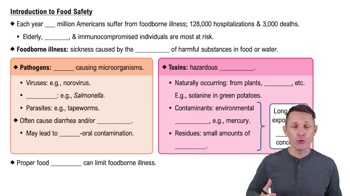
 04:52
04:52