What are proteins and their basic role in the body?
Proteins are macronutrients found in every cell that participate in all cellular activities, including making enzymes and some hormones.
What elements do proteins contain that differentiate them from carbohydrates and lipids?
Proteins contain nitrogen, carbon, hydrogen, and oxygen; some also contain sulfur, which is not found in carbohydrates or lipids.
What are the building blocks of proteins?
Amino acids are the building blocks of proteins, linked by peptide bonds to form peptides and polypeptides.
How are amino acids classified by dietary necessity?
Essential amino acids must be consumed in the diet; nonessential amino acids can be synthesized by the body; conditionally essential amino acids become essential under certain conditions.
What is the structure of an amino acid?
An amino acid contains an amine group (NH2), a carboxylic acid group (COOH), and a unique side chain (R group) that determines its properties.
What is a peptide bond and how is it formed?
A peptide bond forms by condensation when the acid group of one amino acid joins with the amine group of another, releasing water.
What causes protein denaturation and what is its effect?
Heat, acids, bases, salts, and mechanical agitation can denature proteins, altering their shape and function without changing the primary structure.
Where does protein digestion begin and what happens there?
Protein digestion begins in the stomach where HCl denatures proteins and activates pepsin to break polypeptides into shorter chains.
What enzymes are involved in protein digestion in the small intestine?
Pancreatic proteases like trypsin, chymotrypsin, carboxypeptidase, and brush border enzymes like aminopeptidase, dipeptidase, and tripeptidase break peptides into amino acids.
How are amino acids absorbed and utilized after digestion?
Amino acids are absorbed in the small intestine, transported to the liver via the portal vein, then used for protein synthesis, energy, glucose, fat, or released to the bloodstream.
What is the process of protein synthesis?
Protein synthesis involves transcription (DNA to mRNA), translation (mRNA read by ribosomes), and elongation (amino acids linked by tRNA to form proteins).
What happens during deamination of amino acids?
The amine group is removed, forming ammonia which is converted to urea and excreted; the remaining carbon skeleton is used for energy, glucose, or fat.
What is transamination?
Transamination transfers an amine group from one amino acid to a keto acid to form a new nonessential amino acid.
What are the main functions of protein in the body?
Proteins provide structural support, act as enzymes and hormones, regulate fluid and acid-base balance, transport substances, support immunity, provide energy, and increase satiety.
What is nitrogen balance and its significance?
Nitrogen balance is the equilibrium between nitrogen intake and excretion; positive balance supports growth, negative balance indicates tissue loss.
What are the protein intake recommendations for healthy adults?
The RDA is 0.8 grams per kilogram of body weight daily; athletes may require 50-100% more protein.
What defines high-quality protein?
High-quality proteins are digestible, contain all essential amino acids, and provide enough protein to synthesize nonessential amino acids.
What are complementary proteins?
Combining incomplete proteins from different plant sources to provide all essential amino acids, e.g., grains with legumes.
What are the health risks of consuming too much protein?
Excess protein may increase risk of heart disease, kidney stones, and osteoporosis, especially with low calcium intake.
What are the consequences of too little protein intake?
Protein-energy malnutrition leads to impaired immune function, poor digestion, muscle wasting, and conditions like kwashiorkor and marasmus.
What are the types of vegetarian diets?
Types include lacto-vegetarian, lacto-ovo-vegetarian, ovo-vegetarian, vegan, pescetarian, and semivegetarian, differing by animal product inclusion.
What are potential nutrient risks for vegetarians?
Vegetarians may risk low intake of protein, calcium, iron, vitamin B12, zinc, vitamins A and D, and omega-3 fatty acids.
 뒤로
뒤로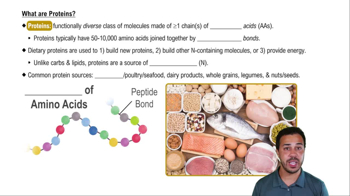
 02:08
02:08