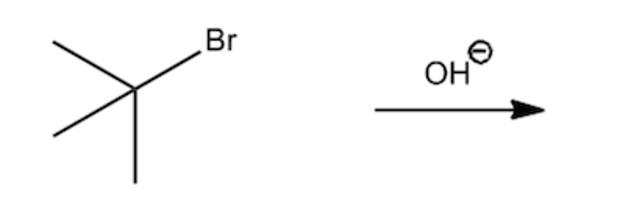
Provide the full mechanism and draw the final product for the following E2 reaction. a.
A
B
C
D
6 댓글
검증된 단계별 안내
1
Identify the type of reaction: The given reaction involves a tertiary alkyl halide (bromine attached to a tertiary carbon) and a strong base (hydroxide ion, OH⁻). This setup is typical for an E2 elimination reaction.
Determine the mechanism: In an E2 reaction, the base abstracts a proton from a β-carbon (a carbon adjacent to the carbon bearing the leaving group), while the leaving group (Br⁻) departs, forming a double bond.
Locate the β-hydrogens: In the given structure, the β-hydrogens are on the methyl groups attached to the tertiary carbon. These are the hydrogens that can be abstracted by the hydroxide ion.
Predict the major product: The major product of an E2 reaction is typically the more substituted alkene, following Zaitsev's rule. This means the double bond will form between the tertiary carbon and the most substituted β-carbon.
Draw the product: Remove the bromine and one β-hydrogen, and form a double bond between the tertiary carbon and the β-carbon from which the hydrogen was removed. This results in the formation of an alkene.


 검증된 단계별 안내

