Put a number in each of the blanks: a. ___ s orbital and ___ p orbitals form ____ sp3 orbitals. b. ___ s orbital and ___ p orbitals form ____ sp2 orbitals. c. ___ s orbital and ___ p orbitals form ____ sp orbitals.
검증된 단계별 안내
1
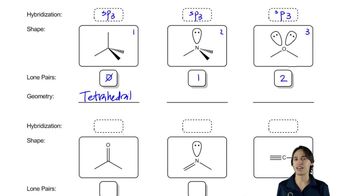
Step 1: Understand the concept of hybridization. Hybridization is the mixing of atomic orbitals to form new hybrid orbitals that are degenerate (of equal energy) and suitable for bonding. The type of hybridization depends on the number of atomic orbitals involved.
Step 2: For sp3 hybridization, one s orbital and three p orbitals combine to form four sp3 hybrid orbitals. This is typically seen in tetrahedral geometries, such as in methane (CH₄).
Step 3: For sp2 hybridization, one s orbital and two p orbitals combine to form three sp2 hybrid orbitals. This is commonly observed in trigonal planar geometries, such as in ethene (C₂H₄).
Step 4: For sp hybridization, one s orbital and one p orbital combine to form two sp hybrid orbitals. This is characteristic of linear geometries, such as in acetylene (C₂H₂).
Step 5: Fill in the blanks based on the above information: (a) 1 s orbital and 3 p orbitals form 4 sp3 orbitals, (b) 1 s orbital and 2 p orbitals form 3 sp2 orbitals, (c) 1 s orbital and 1 p orbital form 2 sp orbitals.
비슷한 문제에 대한 검증된 영상 답변:
이 영상 해법은 위 문제에 도움이 된다고 튜터들이 추천한 것입니다.
영상 길이:
4m
영상 재생:
0 댓글
주요 개념
질문에 올바르게 답하기 위해 반드시 이해해야 하는 핵심 개념들은 다음과 같습니다.
Hybridization
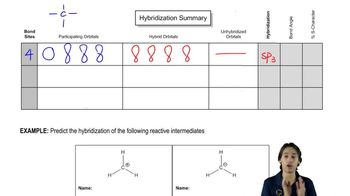
Hybridization is the process of combining atomic orbitals to form new hybrid orbitals that are suitable for the pairing of electrons to form chemical bonds. In organic chemistry, hybridization explains the geometry of molecular structures, such as tetrahedral (sp3), trigonal planar (sp2), and linear (sp) arrangements.
Atomic orbitals are regions in an atom where there is a high probability of finding electrons. The s orbital is spherical, while p orbitals are dumbbell-shaped and oriented along the x, y, and z axes. Understanding the types of orbitals involved in hybridization is crucial for predicting molecular shapes and bond angles.
Molecular geometry refers to the three-dimensional arrangement of atoms within a molecule. The type of hybridization determines the geometry: sp3 hybridization leads to a tetrahedral shape, sp2 results in a trigonal planar shape, and sp gives a linear shape. This geometry influences the physical and chemical properties of the molecules.

 4:28분
4:28분 검증된 단계별 안내
 10:43
10:43