Predict the approximate bond angles: c. the C—N—H bond angle in (CH3)2NH d. the C—N—C bond angle in (CH3)2NH
검증된 단계별 안내
1
Step 1: Understand the molecular geometry around the nitrogen atom in (CH3)2NH. The nitrogen atom in this molecule is sp³ hybridized because it is bonded to two methyl groups (CH3), one hydrogen atom, and has one lone pair of electrons.
Step 2: Recall that sp³ hybridization typically results in a tetrahedral geometry with ideal bond angles of approximately 109.5°. However, the presence of a lone pair on nitrogen will cause slight deviations due to lone pair-bond pair repulsion being greater than bond pair-bond pair repulsion.
Step 3: For part (c), the C—N—H bond angle will be slightly less than 109.5° because the lone pair on nitrogen pushes the bonded atoms closer together, reducing the bond angle.
Step 4: For part (d), the C—N—C bond angle will also be slightly less than 109.5° for the same reason as in part (c). The lone pair on nitrogen exerts repulsion, compressing the bond angles between the bonded groups.
Step 5: Conclude that both the C—N—H and C—N—C bond angles in (CH3)2NH will be slightly less than the ideal tetrahedral angle of 109.5°, but the exact values depend on the specific molecular environment and steric effects.
비슷한 문제에 대한 검증된 영상 답변:
이 영상 해법은 위 문제에 도움이 된다고 튜터들이 추천한 것입니다.
영상 길이:
6m
영상 재생:
0 댓글
주요 개념
질문에 올바르게 답하기 위해 반드시 이해해야 하는 핵심 개념들은 다음과 같습니다.
VSEPR Theory
Valence Shell Electron Pair Repulsion (VSEPR) Theory is a model used to predict the geometry of individual molecules based on the repulsion between electron pairs in the valence shell of the central atom. According to VSEPR, electron pairs will arrange themselves to minimize repulsion, leading to specific bond angles characteristic of different molecular shapes.
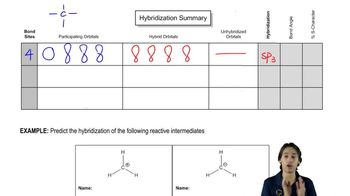
Hybridization is the concept of mixing atomic orbitals to form new hybrid orbitals that can accommodate bonding. In the case of (CH3)2NH, the nitrogen atom undergoes sp3 hybridization, resulting in four equivalent hybrid orbitals that influence the bond angles around the nitrogen atom, typically leading to angles close to 109.5 degrees.
Steric effects refer to the influence of the spatial arrangement of atoms in a molecule on its reactivity and geometry. In (CH3)2NH, the presence of two methyl groups (CH3) attached to the nitrogen creates steric hindrance, which can slightly alter the ideal bond angles due to the repulsion between the bulky groups, affecting the C—N—H and C—N—C angles.

 6:00분
6:00분 검증된 단계별 안내

 10:48
10:48