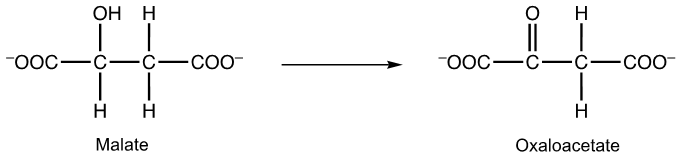
Is the following reaction an oxidation or reduction? Which coenzyme would be carrying this out, NAD+ or NADH?
A
oxidation, NAD+
B
oxidation, NADH
C
reduction, NAD+
D
reduction, NADH
0 댓글
검증된 단계별 안내
1
Examine the chemical structures of Malate and Oxaloacetate. Notice that Malate has a hydroxyl group (-OH) attached to the second carbon, while Oxaloacetate has a carbonyl group (C=O) at the same position.
Identify the change in functional groups from Malate to Oxaloacetate. The conversion of an alcohol group to a carbonyl group is indicative of an oxidation reaction, as it involves the loss of hydrogen atoms.
Understand the role of coenzymes in oxidation-reduction reactions. NAD+ is a common coenzyme that acts as an electron acceptor in oxidation reactions, facilitating the removal of hydrogen atoms.
Recognize that NAD+ is reduced to NADH during the oxidation of Malate to Oxaloacetate. This is because NAD+ gains electrons (and hydrogen) from Malate, becoming NADH.
Conclude that the reaction is an oxidation process, and the coenzyme involved is NAD+, which accepts electrons and hydrogen from Malate, converting it to Oxaloacetate.


 검증된 단계별 안내

