Describe the orbitals used in bonding and the bond angles in the following compounds: a. CH3O-
검증된 단계별 안내
1
Step 1: Identify the central atom in the compound CH3O-. The central atom is oxygen (O) in this case.
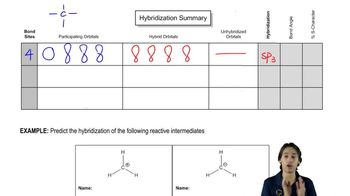
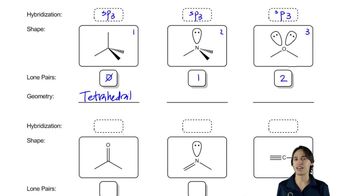
Step 2: Determine the hybridization of the central atom. Oxygen in CH3O- is sp3 hybridized because it forms three sigma bonds (one with carbon and two with hydrogen) and has one lone pair.
Step 3: Describe the orbitals involved in bonding. The oxygen atom uses its sp3 hybrid orbitals to form sigma bonds with the carbon atom and the hydrogen atoms. The carbon atom in CH3 is also sp3 hybridized, using its sp3 orbitals to form sigma bonds with the oxygen and hydrogen atoms.
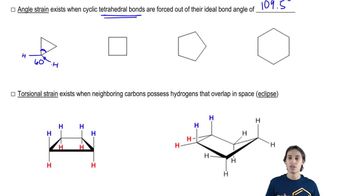
Step 4: Determine the bond angles. In an sp3 hybridized atom, the ideal bond angle is approximately 109.5°. However, due to the presence of a lone pair on oxygen, the bond angle may be slightly less than 109.5°.
Step 5: Consider the effect of the negative charge. The negative charge on the oxygen atom indicates an extra electron, which is accommodated in one of the sp3 hybrid orbitals, contributing to the overall geometry and bond angles.
비슷한 문제에 대한 검증된 영상 답변:
이 영상 해법은 위 문제에 도움이 된다고 튜터들이 추천한 것입니다.
영상 재생:
0 댓글
주요 개념
질문에 올바르게 답하기 위해 반드시 이해해야 하는 핵심 개념들은 다음과 같습니다.
Hybridization
Hybridization is the process by which atomic orbitals mix to form new hybrid orbitals that are suitable for the pairing of electrons to form chemical bonds. In the case of CH3O-, the central atom (carbon) undergoes sp3 hybridization, resulting in four equivalent hybrid orbitals that can form sigma bonds with hydrogen and oxygen.
Bond angles are the angles formed between adjacent bonds in a molecule, which are influenced by the hybridization of the central atom and the repulsion between electron pairs. In CH3O-, the bond angles around the carbon atom are approximately 109.5 degrees, characteristic of sp3 hybridization, while the bond angle between the carbon and oxygen may be slightly less due to lone pair repulsion.
Molecular geometry refers to the three-dimensional arrangement of atoms in a molecule, which is determined by the number of bonding pairs and lone pairs of electrons around the central atom. For CH3O-, the geometry is tetrahedral around the carbon atom, with the presence of a lone pair on the oxygen affecting the overall shape and bond angles.