- 작성 시간을 절약하려면 워크시트를 다운로드하세요
- 연습 문제를 풀기 시작해
- 막히면 영상 해답을 보세요
- 더 많은 인사이트를 원하시면 요약을 참고하세요

We often repeat the same steps when performing synthetic analysis to produce the desired product. To see this in action, use the alkynide synthesis to determine how the following aldehyde is produced, starting with an organic molecule with three or fewer carbons.

Provide the missing products in each step of the given synthesis and show any important stereochemistry.

How could the molecule shown below be synthesized using 2,3-dimethylbut-1-ene as the initial molecule?

Show how you would convert the starting alcohol into the product below.

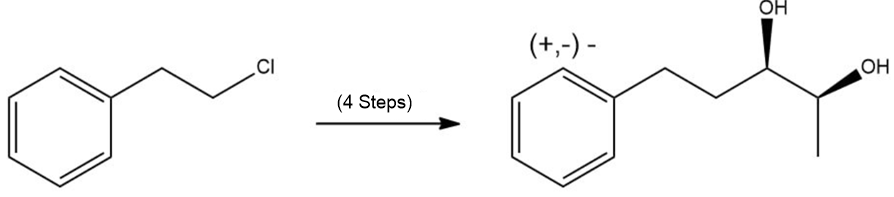
Propose a synthesis of the compound on the right starting with the structure on the left. Although other synthetic routes are possible, the ideal number of steps is shown above the reaction arrow.
Write a possible reaction sequence to synthesize the following aldehyde from the given alkyl halide.
