Skip to main content
Organic Chemistry
나의 코스
배우기
시험 준비
AI 튜터
학습 가이드
교과서적 해결책
플래시카드
탐험해 보세요
앱을 사용해 보세요
나의 코스
배우기
시험 준비
AI 튜터
학습 가이드
교과서적 해결책
플래시카드
탐험해 보세요
앱을 사용해 보세요
뒤로
Alkene Metathesis quiz
카드를 뒤집기 위해 탭할 수 있습니다.
What is alkene metathesis?
카드를 뒤집기 위해 탭할 수 있습니다.
👆
What is alkene metathesis?
Alkene metathesis is a reaction where two alkenes exchange carbon atoms from their double bonds, resulting in new alkenes.
진행 상황 추적
컨트롤 버튼이 '내비게이션' 모드로 변경되었습니다.
1/15
관련 플래시카드
관련 실천
추천 영상
Alkene Metathesis definitions
Alkene Metathesis
15 용어
Alkene Metathesis
35. Transition Metals
5 문제점
주제
Catalytic Allylic Alkylation
35. Transition Metals
5 문제점
주제
27. Transition Metals - Part 1 of 4
6 주제
14 문제점
장
Johnny
35. Transition Metals - Part 2 of 4
4 주제
12 문제점
장
35. Transition Metals - Part 3 of 4
4 주제
12 문제점
장
35. Transition Metals - Part 4 of 4
3 주제
9 문제점
장
VideoThumbView.guidedCourse
1:47
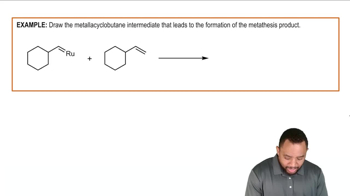
Alkene Metathesis Example 1
746
views
2
rank
VideoThumbView.guidedCourse
1:41
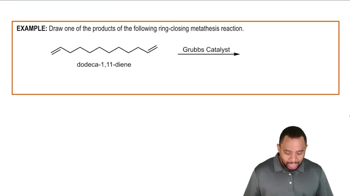
Alkene Metathesis Example 4
627
views
1
rank
VideoThumbView.guidedCourse
3:04
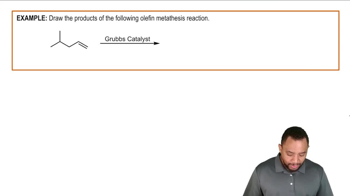
Alkene Metathesis Example 2
621
views
이 집합의 용어 (15)
하이드의 정의
What is alkene metathesis?
Alkene metathesis is a reaction where two alkenes exchange carbon atoms from their double bonds, resulting in new alkenes.
What catalyst is commonly used in alkene metathesis?
Grubbs Catalyst, which contains ruthenium, is commonly used in alkene metathesis.
What types of isomers are produced in alkene metathesis?
A mixture of E and Z isomers is produced, depending on the alignment of the R groups.
What is the role of ethene gas in alkene metathesis?
Ethene gas is highly volatile and bubbles out of solution, driving the reaction to completion.
What is ring-closing metathesis used for?
Ring-closing metathesis is used to synthesize cycloalkenes, especially large rings that are otherwise difficult to make.
Why are dilute solutions used in ring-closing metathesis?
Dilute solutions are used to avoid intermolecular metathesis and favor intramolecular ring formation.
How many phases are there in the alkene metathesis mechanism?
There are two phases: formation of intermediates and their subsequent reaction to yield products.
What is a 2+2 cycloaddition in the context of alkene metathesis?
A 2+2 cycloaddition is a synthetic step that forms a cyclobutane ring between the catalyst and the alkene.
What is cycloreversion?
Cycloreversion is the reverse of cycloaddition, breaking the cyclobutane ring to form intermediates.
What happens in step 1a of phase 1 in the mechanism?
The alkene replaces one of the ligands in the Grubbs catalyst, connecting the alkene to the catalyst.
What is formed during step 1b of phase 1?
A metallocyclobutane ring is formed via 2+2 cycloaddition between the alkene and the Grubbs catalyst.
What is the outcome of step 1c in phase 1?
The metallocyclobutane undergoes cycloreversion, producing two intermediates with ruthenium attached to the alkene carbons.
What occurs in phase 2 of the mechanism?
Each intermediate undergoes another cycle of addition and cycloreversion with an alkene, yielding the final products.
How are E and Z isomers formed in phase 2?
E and Z isomers are formed depending on whether the R groups are on the same or opposite sides after the reaction.
Why does alkene metathesis give the best yields with terminal alkenes?
Terminal alkenes produce ethene gas, which escapes from the solution and shifts the equilibrium toward product formation.
 뒤로뒤로
뒤로뒤로
 1:47
1:47