Skip to main content
Organic Chemistry
나의 코스
배우기
시험 준비
AI 튜터
학습 가이드
교과서적 해결책
플래시카드
탐험해 보세요
앱을 사용해 보세요
나의 코스
배우기
시험 준비
AI 튜터
학습 가이드
교과서적 해결책
플래시카드
탐험해 보세요
앱을 사용해 보세요
뒤로
Anionic Polymerization definitions
카드를 뒤집기 위해 탭할 수 있습니다.
Anionic Polymerization
카드를 뒤집기 위해 탭할 수 있습니다.
👆
Anionic Polymerization
A chain-growth process where alkenes with electron withdrawing groups react with strong nucleophiles, forming living polymers.
진행 상황 추적
컨트롤 버튼이 '내비게이션' 모드로 변경되었습니다.
1/15
관련 플래시카드
관련 실천
추천 영상
Anionic Polymerization quiz
Anionic Polymerization
15 용어
Anionic Polymerization
36. Synthetic Polymers
5 문제점
주제
Polymer Stereochemistry
36. Synthetic Polymers
5 문제점
주제
36. Synthetic Polymers - Part 1 of 4
4 주제
12 문제점
장
36. Synthetic Polymers - Part 2 of 4
4 주제
12 문제점
장
36. Synthetic Polymers - Part 3 of 4
4 주제
12 문제점
장
36. Synthetic Polymers - Part 4 of 4
1 주제
3 문제점
장
VideoThumbView.guidedCourse
0:58
Anionic Polymerization Concept 1
664
views
VideoThumbView.guidedCourse
1:42
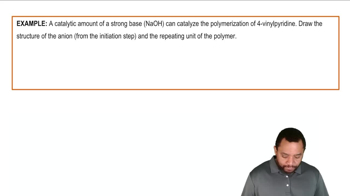
Anionic Polymerization Example 1
603
views
1
rank
VideoThumbView.guidedCourse
1:06
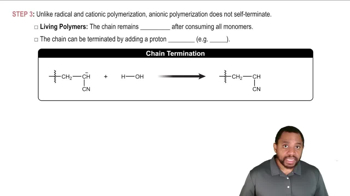
Anionic Polymerization Concept 4
628
views
이 집합의 용어 (15)
하이드의 정의
Anionic Polymerization
A chain-growth process where alkenes with electron withdrawing groups react with strong nucleophiles, forming living polymers.
Alkene
A hydrocarbon containing a carbon-carbon double bond, serving as the monomer in this chain-growth process.
Electron Withdrawing Group
A substituent, such as a nitrile, that stabilizes negative charges formed during the reaction by delocalizing electrons.
Nucleophile
A species, often butyllithium or sodium amide, that donates an electron pair to initiate the polymerization.
Butyllithium
A strong, basic organolithium compound commonly used to initiate the chain reaction by attacking the alkene.
Initiation
The first step where a nucleophile attacks the alkene, generating a stabilized carbanion to start the chain.
Propagation
The step where the active chain end reacts with additional monomer units, extending the polymer via head-to-tail addition.
Termination
The process requiring a proton donor, such as water, to neutralize the active chain end and stop further growth.
Carbanion
A negatively charged carbon intermediate stabilized by electron withdrawing groups during the chain reaction.
Living Polymer
A polymer chain that remains reactive after monomer consumption, allowing further growth until terminated.
Proton Donor
A substance, like water, added to neutralize the carbanion and halt the polymerization process.
Head-to-Tail Addition
A mode of chain extension where the reactive end of the polymer adds to the opposite end of a new monomer.
Nitrile
A functional group containing a carbon triple-bonded to nitrogen, often serving as an electron withdrawing group.
Chain-Growth Polymerization
A polymerization mechanism where monomers add sequentially to an active site, forming long chains.
Hydroxide Ion
A byproduct formed when water donates a proton to the carbanion during the termination step.
 뒤로뒤로
뒤로뒤로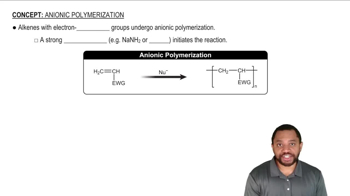
 0:58
0:58