Skip to main content
Organic Chemistry
나의 코스
배우기
시험 준비
AI 튜터
학습 가이드
교과서적 해결책
플래시카드
탐험해 보세요
앱을 사용해 보세요
나의 코스
배우기
시험 준비
AI 튜터
학습 가이드
교과서적 해결책
플래시카드
탐험해 보세요
앱을 사용해 보세요
뒤로
Base Pairing definitions
카드를 뒤집기 위해 탭할 수 있습니다.
Hydrogen Bonding
카드를 뒤집기 위해 탭할 수 있습니다.
👆
Hydrogen Bonding
Intermolecular force responsible for holding complementary bases together, providing overall structural stability to DNA and RNA.
진행 상황 추적
컨트롤 버튼이 '내비게이션' 모드로 변경되었습니다.
1/13
관련 플래시카드
관련 실천
추천 영상
Base Pairing quiz #1
Base Pairing
40 용어
Base Pairing quiz #2
Base Pairing
5 용어
Base Pairing
34. Nucleic Acids
5 문제점
주제
DNA Double Helix
34. Nucleic Acids
5 문제점
주제
34. Nucleic Acids - Part 1 of 2
4 주제
12 문제점
장
34. Nucleic Acids - Part 2 of 2
3 주제
9 문제점
장
VideoThumbView.guidedCourse
2:56
Base Pairing Concept 1
630
views
VideoThumbView.guidedCourse
2:01
Base Pairing Concept 2
590
views
VideoThumbView.guidedCourse
1:46
Base Pairing Example 2
610
views
이 집합의 용어 (13)
하이드의 정의
Hydrogen Bonding
Intermolecular force responsible for holding complementary bases together, providing overall structural stability to DNA and RNA.
Complementary Base Pairing
Specific matching of nitrogenous bases, ensuring accurate pairing and stability in nucleic acid structures.
Adenine
Nitrogenous base that forms two hydrogen bonds with thymine in DNA or uracil in RNA, crucial for genetic coding.
Thymine
Nitrogenous base in DNA that pairs exclusively with adenine through two hydrogen bonds, absent in RNA.
Uracil
Nitrogenous base found in RNA, replacing thymine and pairing with adenine via two hydrogen bonds.
Cytosine
Nitrogenous base that forms three hydrogen bonds with guanine, contributing to increased DNA stability.
Guanine
Nitrogenous base that pairs with cytosine through three hydrogen bonds, enhancing the strength of DNA regions.
Nitrogenous Base
Molecule forming the rungs of DNA and RNA, participating in specific hydrogen bonding for genetic information storage.
Structural Integrity
Overall stability and robustness of DNA or RNA, maintained by numerous hydrogen bonds between paired bases.
Chargaff's Rule
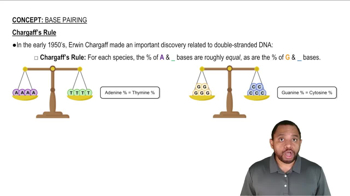
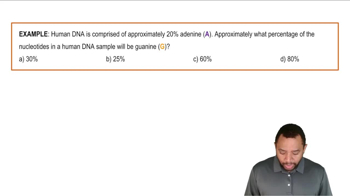
Principle stating that in DNA, the amounts of adenine and thymine are equal, as are cytosine and guanine.
Double-Stranded DNA
Molecular structure where two nucleotide chains are held together by complementary base pairing and hydrogen bonds.
Base Pair
Two nitrogenous bases from opposite strands of DNA or RNA connected by hydrogen bonds, forming the genetic code.
Stabilizing Effect
Collective contribution of multiple hydrogen bonds that strengthens the DNA or RNA molecule.
 뒤로뒤로
뒤로뒤로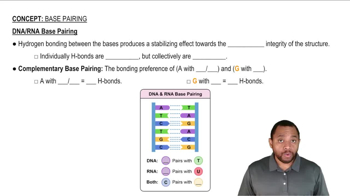
 2:56
2:56