Skip to main content
Organic Chemistry
나의 코스
배우기
시험 준비
AI 튜터
학습 가이드
교과서적 해결책
플래시카드
탐험해 보세요
앱을 사용해 보세요
나의 코스
배우기
시험 준비
AI 튜터
학습 가이드
교과서적 해결책
플래시카드
탐험해 보세요
앱을 사용해 보세요
뒤로
Basicity of Aromatic Heterocycles definitions
카드를 뒤집기 위해 탭할 수 있습니다.
Aromatic Heterocycle
카드를 뒤집기 위해 탭할 수 있습니다.
👆
Aromatic Heterocycle
A ring structure containing at least one non-carbon atom, exhibiting aromatic stability and unique reactivity with acids.
진행 상황 추적
컨트롤 버튼이 '내비게이션' 모드로 변경되었습니다.
1/15
관련 플래시카드
관련 실천
추천 영상
Basicity of Aromatic Heterocycles quiz
Basicity of Aromatic Heterocycles
15 용어
Basicity of Aromatic Heterocycles
18. Aromaticity
3 문제점
주제
Johnny
Ionization of Aromatics
18. Aromaticity
1 문제
주제
Nicole
17. Aromaticity - Part 1 of 3
6 주제
13 문제점
장
Johnny
17. Aromaticity - Part 2 of 3
5 주제
12 문제점
장
Ernest
18. Aromaticity - Part 3 of 3
1 주제
3 문제점
장
02:54
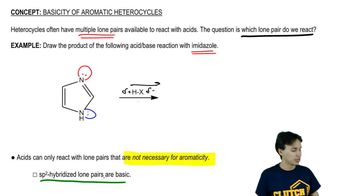
The Sp2 Rule
1918
views
19
rank
7
comments
02:04
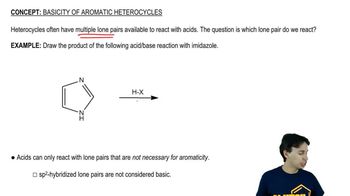
Heterocycles - Which lone pairs react?
2134
views
24
rank
2
comments
03:55
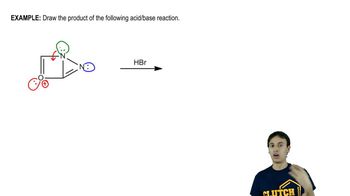
Draw the acid/base reaction product
1987
views
26
rank
19
comments
이 집합의 용어 (15)
하이드의 정의
Aromatic Heterocycle
A ring structure containing at least one non-carbon atom, exhibiting aromatic stability and unique reactivity with acids.
Imidazole
A five-membered aromatic ring with two nitrogens, often used to illustrate basicity and acid reactions in heterocycles.
Lone Pair
A pair of valence electrons on an atom, not involved in bonding, that can participate in acid-base reactions.
Aromaticity
A property of cyclic, planar molecules with delocalized electrons, conferring exceptional stability and resistance to reaction.
HX
A strong halohydric acid, such as HCl, used to probe the basicity of heterocyclic compounds in acid-base reactions.
Acid-Base Reaction
A process where a proton is transferred from an acid to a basic site, often a lone pair, without disrupting aromaticity.
Planarity
A geometric requirement for aromaticity, ensuring all atoms in a ring lie in the same plane for electron delocalization.
Conjugation
A system where p orbitals overlap across adjacent atoms, allowing electron delocalization and contributing to aromatic stability.
Huckel's Rule
A criterion stating that aromatic rings must have 4n+2 π electrons, ensuring maximum stability and aromatic character.
Hybridization
The mixing of atomic orbitals, such as sp2 or sp3, influencing the basicity and reactivity of lone pairs in heterocycles.
Basicity
A measure of how readily a site, often a lone pair, can accept a proton, influenced by its involvement in aromaticity.
Heteroatom
A non-carbon atom, such as nitrogen, within a ring, often bearing lone pairs that can participate in acid-base chemistry.
Protonation
The addition of a hydrogen ion to a basic site, typically a lone pair, which can alter charge but must preserve aromaticity.
Sp2 Hybridized Lone Pair
A non-bonding electron pair on an sp2 hybridized atom, more available for protonation if not involved in aromaticity.
Aromatic Stability
The enhanced resistance to reaction and energy lowering due to electron delocalization in a planar, conjugated ring.
 뒤로뒤로
뒤로뒤로


 02:54
02:54