Organic Chemistry
나의 코스
배우기
시험 준비
AI 튜터
학습 가이드
교과서적 해결책
플래시카드
탐험해 보세요
앱을 사용해 보세요
나의 코스
배우기
시험 준비
AI 튜터
학습 가이드
교과서적 해결책
플래시카드
탐험해 보세요
앱을 사용해 보세요
뒤로
Buchwald-Hartwig Amination Reaction quiz
카드를 뒤집기 위해 탭할 수 있습니다.
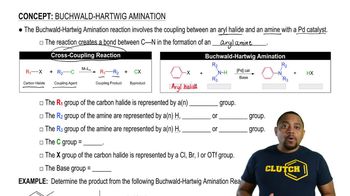
What is the main purpose of the Buchwald-Hartwig amination reaction?
카드를 뒤집기 위해 탭할 수 있습니다.
👆
What is the main purpose of the Buchwald-Hartwig amination reaction?
To couple an aryl halide and an amine using a palladium catalyst, forming a carbon-nitrogen bond and producing an aryl amine.
진행 상황 추적
컨트롤 버튼이 '내비게이션' 모드로 변경되었습니다.
1/15
관련 플래시카드
관련 실천
추천 영상
Buchwald-Hartwig Amination Reaction definitions
Buchwald-Hartwig Amination Reaction
15 용어
Buchwald-Hartwig Amination Reaction
35. Transition Metals
2 문제점
주제

Ernest
27. Transition Metals
6 주제
14 문제점
장
Johnny
VideoThumbView.guidedCourse
03:46
Buchwald-Hartwig Amination Reaction
820
views
VideoThumbView.guidedCourse
05:13
Buchwald-Hartwig Amination Reaction
677
views
VideoThumbView.guidedCourse
01:25
Buchwald-Hartwig Amination Reaction Example 1
956
views
이 집합의 용어 (15)
하이드의 정의
What is the main purpose of the Buchwald-Hartwig amination reaction?
To couple an aryl halide and an amine using a palladium catalyst, forming a carbon-nitrogen bond and producing an aryl amine.
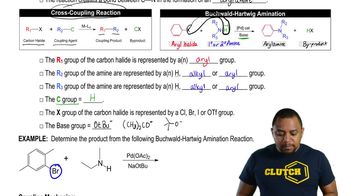
Which catalyst is used in the Buchwald-Hartwig amination reaction?
A palladium complex is used as the catalyst.
What type of amine is typically used in the Buchwald-Hartwig amination reaction?
Primary or secondary amines are typically used, as the nitrogen must have at least one hydrogen.
What are common leaving groups in the aryl halide for this reaction?
Chlorine, bromine, iodine, or triflate are common leaving groups.
What base is commonly used in the Buchwald-Hartwig amination reaction?
Terbutoxide (OTBU-) is commonly used as the base.
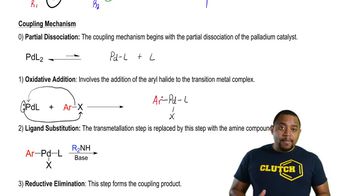
What is the first step in the Buchwald-Hartwig amination mechanism?
Partial dissociation of the palladium catalyst, where one ligand leaves the palladium complex.
What happens during the oxidative addition step?
The aryl halide adds to the palladium complex, forming a bond between palladium and the aryl group as well as the leaving group.
How does the amine attach to the palladium during ligand substitution?
The nitrogen uses its lone pair to bond to the palladium, displacing the halide group.
Why is the nitrogen initially positively charged after ligand substitution?
Because it forms four bonds, which gives it a positive charge until deprotonated by the base.
What role does the base play in the ligand substitution step?
The base deprotonates the nitrogen, neutralizing its charge.
What is formed during the reductive elimination step?
The carbon-nitrogen bond is formed, producing the aryl amine and regenerating the palladium catalyst.
How does the Buchwald-Hartwig amination differ from other cross-coupling reactions in its first step?
It starts with partial dissociation of the palladium catalyst instead of oxidative addition.
What is the generic formula for a cross-coupling reaction as applied to Buchwald-Hartwig amination?
An aryl halide (R1-X) reacts with an amine (R2-NH-R3) in the presence of a palladium catalyst and base to form an aryl amine.
What is the fundamental change occurring in the reaction, in simple terms?
The leaving group (X) from the aryl halide and a hydrogen from the amine are lost, and the remaining groups combine to form the aryl amine.
What is regenerated at the end of the Buchwald-Hartwig amination reaction?
The palladium catalyst is regenerated, allowing the reaction to be catalytic.