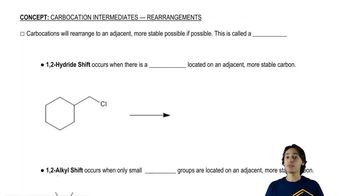
What is a carbocation rearrangement and why does it occur?
A carbocation rearrangement is when a carbocation moves to a more stable position, usually to increase its stability by forming a more substituted carbocation.
What is the most common type of carbocation shift?
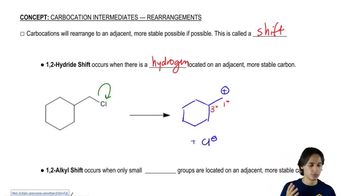
The most common type is the 1,2-hydride shift, where a hydrogen atom moves to the carbocation to create a more stable carbocation.
Under what condition does a 1,2-hydride shift occur?
A 1,2-hydride shift occurs when there is a hydrogen on an adjacent, more stable carbon next to the carbocation.
Why do you draw the arrow from the hydrogen bond to the carbocation in a hydride shift?
Because electrons move from the more negative (the bond) to the more positive (the carbocation), not from the positive charge itself.
What happens to the original carbocation carbon after a hydride shift?
It gains a hydrogen and becomes neutral, while the carbocation moves to the carbon that lost the hydrogen.
What is a 1,2-alkyl shift and when does it occur?
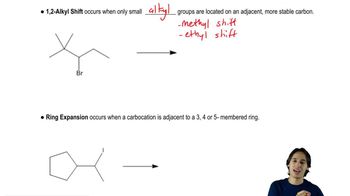
A 1,2-alkyl shift is when an alkyl group (like methyl or ethyl) moves to the carbocation, and it occurs only if no hydrogens are available for a hydride shift.
Why are methyl shifts more common than ethyl or larger alkyl shifts?
Because moving larger alkyl groups requires more energy, making methyl shifts easier and more common.
What is the order of preference for carbocation shifts?
Hydride shifts are preferred first, followed by methyl shifts, and then ethyl shifts as a last resort.
What is a ring expansion in carbocation rearrangements?
A ring expansion occurs when a carbocation is adjacent to a small ring (3, 4, or 5-membered), causing the ring to expand and relieve strain.
Why do small rings undergo ring expansion during carbocation rearrangement?
Small rings are strained, so expanding the ring relieves strain and forms a more stable, larger ring with the carbocation.
After a ring expansion, where is the carbocation located?
The carbocation ends up on the carbon that was adjacent to the original ring, now part of the expanded ring.
What determines whether a carbocation will rearrange?
A carbocation will rearrange if it can move to a more stable position, such as from primary to secondary or tertiary, or to relieve ring strain.
Why are 1,2-hydride shifts easier than 1,2-alkyl shifts?
Because moving a hydrogen requires less energy than moving an alkyl group, making hydride shifts more favorable.
What is the general mechanism for a carbocation rearrangement?
The mechanism involves the movement of a group (hydride or alkyl) from a neighboring carbon to the carbocation, guided by electron movement from negative to positive centers.
What two questions should you ask when analyzing a carbocation rearrangement problem?
First, ask if the carbocation will rearrange; second, if it does, determine what the new structure will look like after the shift.
 뒤로
뒤로

 03:43
03:43