Skip to main content
Organic Chemistry
나의 코스
배우기
시험 준비
AI 튜터
학습 가이드
교과서적 해결책
플래시카드
탐험해 보세요
앱을 사용해 보세요
나의 코스
배우기
시험 준비
AI 튜터
학습 가이드
교과서적 해결책
플래시카드
탐험해 보세요
앱을 사용해 보세요
뒤로
Cope Elimination quiz
카드를 뒤집기 위해 탭할 수 있습니다.
What type of compound undergoes the Cope elimination reaction?
카드를 뒤집기 위해 탭할 수 있습니다.
👆
What type of compound undergoes the Cope elimination reaction?
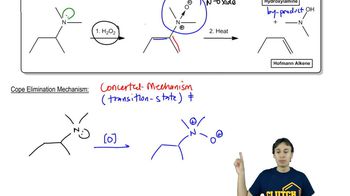
Tertiary amine oxides (N-oxides) undergo the Cope elimination reaction.
진행 상황 추적
컨트롤 버튼이 '내비게이션' 모드로 변경되었습니다.
1/15
관련 플래시카드
관련 실천
추천 영상
Cope Elimination definitions
Cope Elimination
13 용어
Cope Elimination
26. Amines
4 문제점
주제
Laura
Hofmann Elimination
26. Amines
2 문제점
주제
Johnny
23. Amines - Part 1 of 3
4 주제
11 문제점
장
Nicole
23. Amines - Part 2 of 3
5 주제
13 문제점
장
Nicole
26. Amines - Part 3 of 3
1 주제
3 문제점
장
04:09
General Reaction
1510
views
8
rank
1
comments
04:24
Mechanism
1423
views
7
rank
3
comments
04:20
Predict the Product
1448
views
8
rank
1
comments
이 집합의 용어 (15)
하이드의 정의
What type of compound undergoes the Cope elimination reaction?
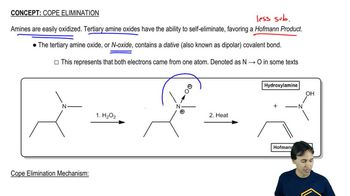
Tertiary amine oxides (N-oxides) undergo the Cope elimination reaction.
What is the main product formed in a Cope elimination?
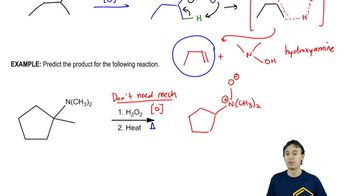
The main product is a Hofmann alkene, which is the less substituted elimination product.
What is the byproduct of the Cope elimination reaction?
The byproduct is hydroxylamine, specifically an N-methyl methyl hydroxylamine.
What type of mechanism does the Cope elimination follow?
It follows a concerted mechanism, meaning all bond changes occur in a single step via a transition state.
What is a dative or dipolar covalent bond in the context of amine oxides?
It is a covalent bond where nitrogen donates a lone pair to oxygen, resulting in separated positive and negative charges.
How can tertiary amine oxides be formed in the laboratory?
They can be formed by oxidizing tertiary amines with weak oxidizing agents like hydrogen peroxide or even atmospheric oxygen.
What does the term 'N-oxide' refer to?
It refers to a structure where an oxygen atom is directly bonded to a nitrogen atom in a tertiary amine.
Why is the Hofmann product favored in the Cope elimination?
Because the elimination occurs at the least substituted position, leading to the less substituted alkene.
What is the role of heat in the Cope elimination?
Heat is required to initiate the self-elimination of the N-oxide, driving the reaction forward.
How is the transition state in the Cope elimination depicted?
It is shown with partial (dotted) bonds indicating simultaneous bond breaking and forming, and is enclosed in brackets with a double dagger symbol.
What happens to the N–O bond during the Cope elimination?
The N–O bond remains intact during the transition state and is part of the concerted elimination process.
What is the difference between the Zaitsev and Hofmann products?
The Zaitsev product is the more substituted alkene, while the Hofmann product is the less substituted alkene.
What is the significance of the positive and negative charges in the N-oxide structure?
The nitrogen carries a positive charge and the oxygen a negative charge, reflecting the dipolar nature of the bond.
Can the Cope elimination occur with primary or secondary amines?
No, it specifically requires tertiary amine oxides for the reaction to proceed.
What is the first step in the Cope elimination mechanism?
The first step is the oxidation of a tertiary amine to form the corresponding N-oxide.
 뒤로뒤로
뒤로뒤로


 04:09
04:09