Organic Chemistry
나의 코스
배우기
시험 준비
AI 튜터
학습 가이드
교과서적 해결책
플래시카드
탐험해 보세요
앱을 사용해 보세요
나의 코스
배우기
시험 준비
AI 튜터
학습 가이드
교과서적 해결책
플래시카드
탐험해 보세요
앱을 사용해 보세요
뒤로
Cross-Coupling General Reactions definitions
카드를 뒤집기 위해 탭할 수 있습니다.
Cross Coupling Reaction
카드를 뒤집기 위해 탭할 수 있습니다.
👆
Cross Coupling Reaction
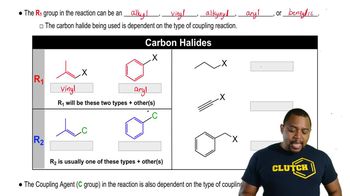
Synthetic process combining a carbon halide and a coupling agent, forming new carbon-carbon bonds via a transition metal catalyst.
진행 상황 추적
컨트롤 버튼이 '내비게이션' 모드로 변경되었습니다.
1/15
관련 플래시카드
관련 실천
추천 영상
Cross-Coupling General Reactions quiz
Cross-Coupling General Reactions
15 용어
Heck Reaction
35. Transition Metals
7 문제점
주제

Johnny
27. Transition Metals
6 주제
14 문제점
장
Johnny
VideoThumbView.guidedCourse
04:10
Overview of Cross-Coupling General Reactions
963
views
6
rank
VideoThumbView.guidedCourse
03:28
Cross-Coupling Reaction Mechanisms
1009
views
6
rank
VideoThumbView.guidedCourse
02:46
Cross-Coupling Reaction Mechanisms Example 3
872
views
5
rank
이 집합의 용어 (15)
하이드의 정의
Cross Coupling Reaction
Synthetic process combining a carbon halide and a coupling agent, forming new carbon-carbon bonds via a transition metal catalyst.
Transition Metal Catalyst
Central metal species, often palladium or nickel, facilitating bond formation and following the 18 or 16 electron rule.
18 Electron Rule
Stability guideline for transition metals, where achieving 18 valence electrons mimics noble gas configuration.
16 Electron Rule
Alternative stability guideline for certain transition metals, especially those with valence groups 8 to 11.
Carbon Halide
Organic molecule containing a carbon atom bonded to a halogen, serving as a key reactant in coupling reactions.
Coupling Agent
Reactant providing a carbon group, typically vinyl or aryl, that combines with a carbon halide to form the product.
Ligand
Molecule or ion bound to a transition metal, influencing its reactivity and electron count during the catalytic cycle.
Oxidative Addition
Mechanistic stage where a transition metal inserts into a carbon-halide bond, increasing its electron count by two.
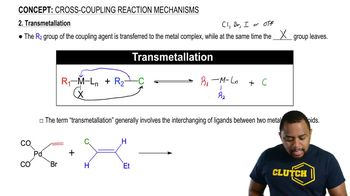
Transmetalation
Stage where a carbon group from the coupling agent replaces the halide on the metal complex, exchanging ligands.
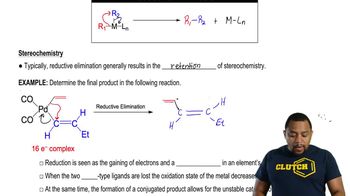
Reductive Elimination
Final mechanistic step where two carbon groups bond, regenerating the catalyst and forming the main product.
Conjugated Product
Molecule with alternating single and double bonds, resulting in enhanced stability and often a reaction's driving force.
Catalytic Cycle
Sequence of steps involving catalyst regeneration, enabling repeated product formation without catalyst consumption.
Byproduct
Substance formed alongside the desired product, typically discarded and not central to the reaction's purpose.
Aryl Halide
Compound featuring a benzene ring bonded to a halogen, commonly used as a reactant in coupling reactions.
Vinyl Halide
Molecule with a halogen attached to an alkene carbon, serving as a reactive partner in cross coupling.