Skip to main content
Organic Chemistry
나의 코스
배우기
시험 준비
AI 튜터
학습 가이드
교과서적 해결책
플래시카드
탐험해 보세요
앱을 사용해 보세요
나의 코스
배우기
시험 준비
AI 튜터
학습 가이드
교과서적 해결책
플래시카드
탐험해 보세요
앱을 사용해 보세요
뒤로
Curtius Rearrangement quiz
카드를 뒤집기 위해 탭할 수 있습니다.
What is the Curtius rearrangement also known as?
카드를 뒤집기 위해 탭할 수 있습니다.
👆
What is the Curtius rearrangement also known as?
It is also known as the reduction of acyl azide.
진행 상황 추적
컨트롤 버튼이 '내비게이션' 모드로 변경되었습니다.
1/15
관련 플래시카드
관련 실천
추천 영상
Curtius Rearrangement definitions
Curtius Rearrangement
15 용어
Curtius Rearrangement
26. Amines
5 문제점
주제
Hofmann Rearrangement
26. Amines
5 문제점
주제
23. Amines - Part 1 of 3
4 주제
11 문제점
장
Nicole
23. Amines - Part 2 of 3
5 주제
13 문제점
장
Nicole
26. Amines - Part 3 of 3
1 주제
3 문제점
장
04:46
Propose a Synthesis
1001
views
4
rank
3
comments
10:14
General Mechanism
1158
views
7
rank
2
comments
이 집합의 용어 (15)
하이드의 정의
What is the Curtius rearrangement also known as?
It is also known as the reduction of acyl azide.
What are the two reagents required for the Curtius rearrangement?
The reaction requires only heat and water.
What is the starting material for the Curtius rearrangement?
The starting material is an acyl azide.
What is the main organic product of the Curtius rearrangement?
The main product is a primary amine.
What key intermediate is formed during the Curtius rearrangement after heating?
An isocyanate intermediate is formed after heating.
What highly reactive intermediate is generated during the mechanism?
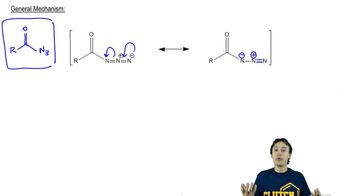
A nitrene intermediate is generated, which is highly reactive due to an incomplete octet.
What gases are released during the Curtius rearrangement?
CO2 and N2 gases are released.
What is the role of water in the Curtius rearrangement?
Water attacks the isocyanate carbon, leading to decarboxylation and formation of the primary amine.
What is the resonance structure of the azide group important for in this reaction?
It helps explain the stability of N2 gas and why the reaction proceeds under heat.
What is the significance of the nitrene intermediate in the Curtius rearrangement?
The nitrene is highly reactive and rearranges to form the isocyanate.
What is the structure called that forms after water attacks the isocyanate?
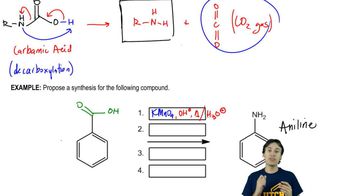
It forms carbamic acid, which is unstable and decarboxylates.
Why is N2 gas considered highly stable in this reaction?
N2 gas is highly stable because it makes up 78% of the atmosphere and is unreactive.
What happens to the carbonyl group during the Curtius rearrangement?
The carbonyl group is lost as CO2 gas during decarboxylation.
Why might a chemist use the Curtius rearrangement in synthesis?
It is used to synthesize a primary amine while losing a carbon atom from the starting material.
What is the final step in the Curtius rearrangement mechanism?
The final step is decarboxylation of carbamic acid to yield a primary amine and CO2 gas.
 뒤로뒤로
뒤로뒤로
 04:46
04:46