Skip to main content
Organic Chemistry
나의 코스
배우기
시험 준비
AI 튜터
학습 가이드
교과서적 해결책
플래시카드
탐험해 보세요
앱을 사용해 보세요
나의 코스
배우기
시험 준비
AI 튜터
학습 가이드
교과서적 해결책
플래시카드
탐험해 보세요
앱을 사용해 보세요
뒤로
E1 Reaction definitions
카드를 뒤집기 위해 탭할 수 있습니다.
E1 Mechanism
카드를 뒤집기 위해 탭할 수 있습니다.
👆
E1 Mechanism
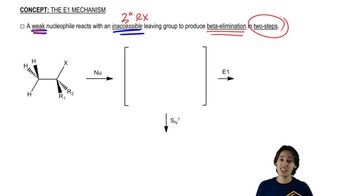
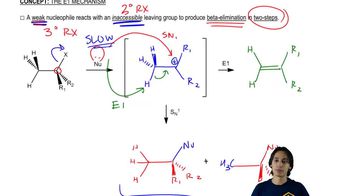
A two-step elimination process where a weak nucleophile and a tertiary leaving group yield a carbocation intermediate before forming a double bond.
진행 상황 추적
컨트롤 버튼이 '내비게이션' 모드로 변경되었습니다.
1/15
관련 플래시카드
관련 실천
추천 영상
E1 Reaction quiz #1
The E1 Mechanism
9 용어
E1 Reaction
8. Elimination Reactions
7 문제점
주제
Ernest
Solvents
8. Elimination Reactions
4 문제점
주제
Ernest
8. Elimination Reactions - Part 1 of 3
5 주제
11 문제점
장
Johnny
8. Elimination Reactions - Part 2 of 3
5 주제
13 문제점
장
Ernest
8. Elimination Reactions - Part 3 of 3
1 주제
3 문제점
장
03:32
Understanding the properties of E1.
4389
views
43
rank
14
comments
08:09
Drawing the E1 Mechanism.
5369
views
71
rank
27
comments
이 집합의 용어 (15)
하이드의 정의
E1 Mechanism
A two-step elimination process where a weak nucleophile and a tertiary leaving group yield a carbocation intermediate before forming a double bond.
SN1 Mechanism
A substitution pathway involving carbocation formation, followed by nucleophilic attack, often producing racemic mixtures due to chiral centers.
Carbocation
A positively charged intermediate formed after the leaving group departs, crucial for both E1 and SN1 reactions.
Leaving Group
An atom or group that departs from the substrate, enabling carbocation formation and dictating reaction rate.
Nucleophile
A species with lone pairs that can act as a base or attacker, but in E1, typically waits for carbocation formation.
Beta Proton
A hydrogen atom on a carbon adjacent to the carbocation, abstracted during the elimination step to form a double bond.
Double Bond
A feature in the elimination product resulting from the removal of a beta proton and electrons filling the carbocation.
Tertiary Alkyl Halide
A substrate with three alkyl groups attached to the carbon bearing the leaving group, favoring carbocation stability.
Racemization
The process leading to equal amounts of enantiomers, common in SN1 due to attack on planar carbocations.
Unimolecular Kinetics
A rate law dependent only on the substrate concentration, not on nucleophile or base concentration.
Mixture of Products
A common outcome in E1 and SN1, where multiple substitution and elimination products are formed, complicating synthesis.
Stereochemistry
The spatial arrangement of atoms, which is not a concern in E1 due to the absence of geometric requirements.
Anticoplanar Geometry
A spatial requirement for E2 reactions, but not necessary in E1 since the leaving group has already departed.
Intermediate
A species, such as a carbocation, formed between steps in a reaction mechanism, distinct from a transition state.
Synthesis
The process of constructing target molecules, often hindered by E1 and SN1 due to the formation of multiple similar products.
 뒤로뒤로
뒤로뒤로

 03:32
03:32