Organic Chemistry
나의 코스
배우기
시험 준비
AI 튜터
학습 가이드
교과서적 해결책
플래시카드
탐험해 보세요
앱을 사용해 보세요
나의 코스
배우기
시험 준비
AI 튜터
학습 가이드
교과서적 해결책
플래시카드
탐험해 보세요
앱을 사용해 보세요
뒤로
Electron Configuration of Elements definitions
카드를 뒤집기 위해 탭할 수 있습니다.
Electron Configuration
카드를 뒤집기 위해 탭할 수 있습니다.
👆
Electron Configuration
Arrangement of electrons in shells and orbitals, following a specific order based on the periodic table's blocks.
진행 상황 추적
컨트롤 버튼이 '내비게이션' 모드로 변경되었습니다.
1/15
관련 플래시카드
관련 실천
추천 영상
Electron Configuration of Elements quiz
Electron Configuration of Elements
10 용어
27. Transition Metals
6 주제
14 문제점
장
Johnny
VideoThumbView.guidedCourse
05:03
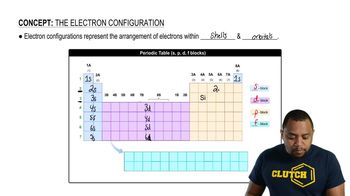
The Electron Configuration
1184
views
VideoThumbView.guidedCourse
01:52
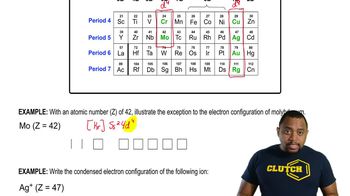
Electron Configuration Exceptions Exercise 1
841
views
1
rank
VideoThumbView.guidedCourse
02:54
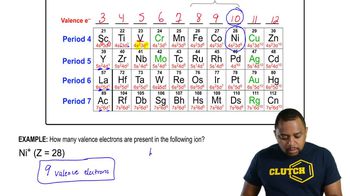
Valence Electrons of Transition Metals Example 1
1015
views
1
rank
이 집합의 용어 (15)
하이드의 정의
Electron Configuration
Arrangement of electrons in shells and orbitals, following a specific order based on the periodic table's blocks.
Orbital
Region within an atom where electrons are most likely to be found, each with a defined shape and capacity.
S Block
Section of the periodic table containing elements with valence electrons in s orbitals, holding up to 2 electrons per row.
P Block
Section of the periodic table where elements fill p orbitals, each row accommodating up to 6 electrons.
D Block
Region of the periodic table for transition metals, where d orbitals are filled, holding up to 10 electrons per row.
F Block
Area of the periodic table with elements filling f orbitals, each row capable of holding up to 14 electrons.
Condensed Electron Configuration
Shorthand notation for electron arrangement, starting from the last noble gas before the element.
Cation
Positively charged ion formed by the removal of electrons, with electrons lost from the highest shell number first.
Principal Quantum Number
Number indicating the main energy level or shell of an electron, determining its average distance from the nucleus.
Transition Metal
Element found in the d block, characterized by filling s orbitals before d orbitals and often showing electron configuration exceptions.
Valence Electrons
Electrons in the outermost shell involved in bonding; for main group elements, equal to group number; for transition metals, sum of s and d electrons.
Hund's Rule
Guideline stating that electrons occupy degenerate orbitals singly before pairing, maximizing unpaired electrons for stability.
Electron Configuration Exception
Irregular arrangement in some transition metals where s electrons are promoted to d orbitals for half-filled or fully filled stability.
Noble Gas
Element in group 8 of the periodic table, used as a reference point in condensed electron configurations.
Main Group Element
Element in groups 1–8 (A groups), with valence electrons corresponding directly to its group number.