Skip to main content
Organic Chemistry
나의 코스
배우기
시험 준비
AI 튜터
학습 가이드
교과서적 해결책
플래시카드
탐험해 보세요
앱을 사용해 보세요
나의 코스
배우기
시험 준비
AI 튜터
학습 가이드
교과서적 해결책
플래시카드
탐험해 보세요
앱을 사용해 보세요
뒤로
Enantiomeric Excess quiz
카드를 뒤집기 위해 탭할 수 있습니다.
What is the specific rotation of a pure enantiomer sample?
카드를 뒤집기 위해 탭할 수 있습니다.
👆
What is the specific rotation of a pure enantiomer sample?
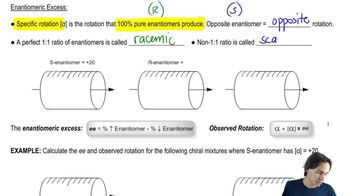
The specific rotation is the observed rotation when 100% of one enantiomer is present in the sample.
진행 상황 추적
컨트롤 버튼이 '내비게이션' 모드로 변경되었습니다.
1/15
관련 플래시카드
관련 실천
추천 영상
Enantiomeric Excess definitions
Enantiomeric Excess
13 용어
Enantiomeric Excess
5. Chirality
4 문제점
주제
Johnny
Calculations with Enantiomeric Percentages
5. Chirality
5 문제점
주제
Ernest
5. Chirality - Part 1 of 4
4 주제
15 문제점
장
Johnny
5. Chirality - Part 2 of 4
6 주제
15 문제점
장
Johnny
5. Chirality - Part 3 of 4
6 주제
15 문제점
장
Johnny
5. Chirality - Part 4 of 4
2 주제
5 문제점
장
00:50
Calculating Enantiomeric Excess and Observed Rotation
3007
views
13
rank
1
comments
04:21
How to calculate enantiomeric excess.
3503
views
19
rank
2
comments
03:59
Calculating Enantiomeric Excess and Observed Rotation
2890
views
22
rank
5
comments
이 집합의 용어 (15)
하이드의 정의
What is the specific rotation of a pure enantiomer sample?
The specific rotation is the observed rotation when 100% of one enantiomer is present in the sample.
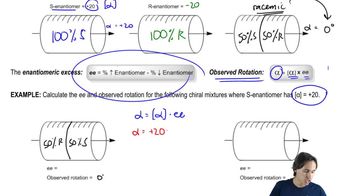
What happens to the observed rotation if you have 100% of the R enantiomer and its specific rotation is +10 degrees?
The observed rotation would be +10 degrees.
What is the observed rotation if you have 100% of the S enantiomer and its specific rotation is +10 degrees?
The observed rotation would be -10 degrees, the same magnitude but opposite sign.
What do you call a mixture with a 1:1 ratio of enantiomers?
A 1:1 mixture of enantiomers is called racemic.
What is the observed optical rotation of a racemic mixture?
The observed rotation is zero because the rotations of the two enantiomers cancel each other out.
What is a scalemic mixture?
A scalemic mixture is a non-1:1 mixture of enantiomers, meaning the proportions are not equal.
How do you calculate enantiomeric excess (ee)?
Enantiomeric excess is calculated by subtracting the percentage of the minor enantiomer from the percentage of the major enantiomer.
What does enantiomeric excess represent in a mixture?
It represents the percentage of the mixture that is optically active and not canceled out by the other enantiomer.
How do you calculate the observed rotation of a mixture using enantiomeric excess?
Multiply the specific rotation of the pure enantiomer by the enantiomeric excess (expressed as a decimal).
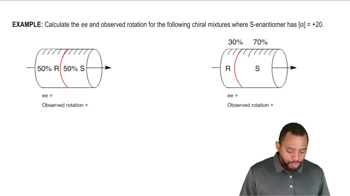
If a mixture contains 70% R and 30% S enantiomer, what is the enantiomeric excess?
The enantiomeric excess is 40% (70% - 30%).
If the specific rotation of the S enantiomer is +20, what is the observed rotation for a 100% S sample?
The observed rotation would be +20.
If you have 50% S and 50% R enantiomers, what is the enantiomeric excess?
The enantiomeric excess is 0%.
Why does a racemic mixture have no optical activity?
Because the optical rotations of the two enantiomers are equal in magnitude but opposite in direction, so they cancel out.
What is the formula for observed rotation in terms of specific rotation and enantiomeric excess?
Observed rotation = specific rotation × enantiomeric excess (as a decimal).
Why is enantiomeric excess important in organic chemistry?
It helps determine the net optical activity of a mixture and indicates the proportion of one enantiomer over the other.
 뒤로뒤로
뒤로뒤로

 00:50
00:50