Skip to main content
Organic Chemistry
나의 코스
배우기
시험 준비
AI 튜터
학습 가이드
교과서적 해결책
플래시카드
탐험해 보세요
앱을 사용해 보세요
나의 코스
배우기
시험 준비
AI 튜터
학습 가이드
교과서적 해결책
플래시카드
탐험해 보세요
앱을 사용해 보세요
뒤로
Hofmann Rearrangement definitions
카드를 뒤집기 위해 탭할 수 있습니다.
Hofmann Rearrangement
카드를 뒤집기 위해 탭할 수 있습니다.
👆
Hofmann Rearrangement
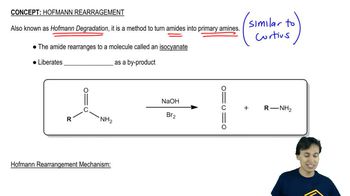
A process converting amides to primary amines via isocyanate formation, with CO2 and water as byproducts.
진행 상황 추적
컨트롤 버튼이 '내비게이션' 모드로 변경되었습니다.
1/14
관련 플래시카드
관련 실천
추천 영상
Hofmann Rearrangement quiz
Hofmann Rearrangement
15 용어
Hofmann Rearrangement
26. Amines
5 문제점
주제
Hofmann Elimination
26. Amines
2 문제점
주제
Johnny
23. Amines - Part 1 of 3
4 주제
11 문제점
장
Nicole
23. Amines - Part 2 of 3
5 주제
13 문제점
장
Nicole
26. Amines - Part 3 of 3
1 주제
3 문제점
장
07:18
Mechanism
786
views
5
rank
5
comments
02:51
General Reaction
810
views
5
rank
1
comments
이 집합의 용어 (14)
하이드의 정의
Hofmann Rearrangement
A process converting amides to primary amines via isocyanate formation, with CO2 and water as byproducts.
Amide
A starting material featuring a carbonyl group bonded to nitrogen, essential for this transformation.
Primary Amine
The main organic product, characterized by a nitrogen atom bonded to one alkyl or aryl group and two hydrogens.
Isocyanate
A stable intermediate with a structure R–N=C=O, formed during the rearrangement before amine production.
N-Bromoamide
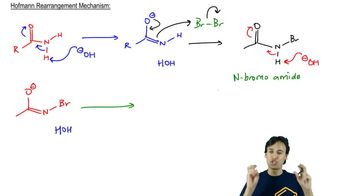
A key intermediate where bromine is directly attached to the nitrogen of an amide, enabling rearrangement.
Sodium Hydroxide
A common base used to deprotonate the amide, making it nucleophilic for subsequent steps.
Bromine
An electrophilic reagent (Br2) that reacts with the nucleophilic amide to form N-bromoamide.
Nucleophile
A species with electron-rich sites, such as deprotonated amide nitrogen, that attacks electrophiles.
Electrophile
A species like Br2 or isocyanate carbon, which accepts electrons from nucleophiles during the reaction.
Rearrangement
A mechanistic step where the R group migrates from the carbonyl carbon to nitrogen, forming isocyanate.
Decarboxylation
A step removing a carboxyl group as CO2, finalizing the conversion to a primary amine.
CO2
A gaseous byproduct released during decarboxylation, indicating completion of the rearrangement.
Water
A byproduct formed during deprotonation and other steps, not the main focus of the reaction.
Curtius Rearrangement
A mechanistically similar reaction involving isocyanate intermediates and CO2 release.
 뒤로뒤로
뒤로뒤로

 07:18
07:18