Skip to main content
Organic Chemistry
나의 코스
배우기
시험 준비
AI 튜터
학습 가이드
교과서적 해결책
플래시카드
탐험해 보세요
앱을 사용해 보세요
나의 코스
배우기
시험 준비
AI 튜터
학습 가이드
교과서적 해결책
플래시카드
탐험해 보세요
앱을 사용해 보세요
뒤로
Intramolecular Nucleophilic Catalysis definitions
카드를 뒤집기 위해 탭할 수 있습니다.
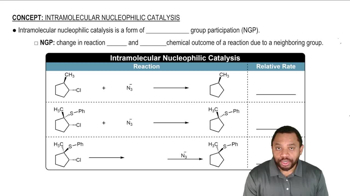
Intramolecular Nucleophilic Catalysis
카드를 뒤집기 위해 탭할 수 있습니다.
👆
Intramolecular Nucleophilic Catalysis
A process where a group within a molecule accelerates reaction by assisting nucleophile attack, often increasing reaction speed.
진행 상황 추적
컨트롤 버튼이 '내비게이션' 모드로 변경되었습니다.
1/15
관련 플래시카드
관련 실천
추천 영상
Intramolecular Nucleophilic Catalysis quiz
Intramolecular Nucleophilic Catalysis
15 용어
Intramolecular Nucleophilic Catalysis
31. Catalysis in Organic Reactions
5 문제점
주제
Intramolecular Acid-Base Catalysis
31. Catalysis in Organic Reactions
5 문제점
주제
31. Catalysis in Organic Reactions - Part 1 of 2
4 주제
12 문제점
장
31. Catalysis in Organic Reactions - Part 2 of 2
4 주제
12 문제점
장
VideoThumbView.guidedCourse
1:35
Intramolecular Nucleophilic Catalysis Example 1
477
views
VideoThumbView.guidedCourse
4:01
Intramolecular Nucleophilic Catalysis Concept 1
452
views
이 집합의 용어 (15)
하이드의 정의
Intramolecular Nucleophilic Catalysis
A process where a group within a molecule accelerates reaction by assisting nucleophile attack, often increasing reaction speed.
Neighboring Group Participation
A phenomenon where an adjacent group influences reaction rate and stereochemistry by interacting with the reaction center.
Azide Ion
A negatively charged nucleophile that attacks electrophilic carbons, often causing inversion of configuration in SN2 reactions.
Cyclopentane Ring
A five-membered carbon ring structure that can host various substituents, affecting reaction pathways and rates.
SN2 Reaction
A substitution mechanism where a nucleophile attacks from the opposite side, causing inversion of configuration.
Inversion of Configuration
A stereochemical outcome where the spatial arrangement of groups around a carbon flips during nucleophilic substitution.
Steric Hindrance
A slowdown in reaction rate caused by bulky groups blocking access to the reactive site.
Angle Strain
A destabilizing effect in small rings, like three-membered rings, due to bond angles deviating from ideal values.
Leaving Group
An atom or group that departs with a pair of electrons during a substitution or elimination reaction.
Benzene Ring
A planar, six-carbon aromatic ring that, when attached to other atoms, can increase steric bulk and affect reactivity.
Three-Membered Ring
A strained cyclic intermediate formed during some intramolecular reactions, prone to nucleophilic attack.
Methyl Group
A small alkyl substituent that can influence reaction rates by contributing to steric effects.
Phenyl Group
An aromatic substituent derived from benzene, often increasing steric hindrance when attached to a molecule.
Relative Rate
A comparison of how quickly different reaction pathways proceed under similar conditions.
Epoxide Ring Opening
A process where a nucleophile attacks a strained three-membered ring, typically at the less substituted carbon.
 뒤로뒤로
뒤로뒤로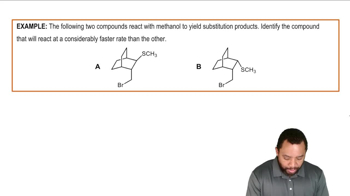
 1:35
1:35