Skip to main content
Organic Chemistry
나의 코스
배우기
시험 준비
AI 튜터
학습 가이드
교과서적 해결책
플래시카드
탐험해 보세요
앱을 사용해 보세요
나의 코스
배우기
시험 준비
AI 튜터
학습 가이드
교과서적 해결책
플래시카드
탐험해 보세요
앱을 사용해 보세요
뒤로
Isoelectric Point quiz
카드를 뒤집기 위해 탭할 수 있습니다.
What is the isoelectric point (pI) of an amino acid?
카드를 뒤집기 위해 탭할 수 있습니다.
👆
What is the isoelectric point (pI) of an amino acid?
The isoelectric point is the pH at which an amino acid has zero net charge, meaning the greatest concentration of zwitterions is present.
진행 상황 추적
컨트롤 버튼이 '내비게이션' 모드로 변경되었습니다.
1/15
관련 플래시카드
관련 실천
추천 영상
Isoelectric Point definitions
Isoelectric Point
15 용어
Isoelectric Point
29. Amino Acids
6 문제점
주제
Johnny
Amino Acid Synthesis: HVZ Method
29. Amino Acids
5 문제점
주제
26. Amino Acids, Peptides, and Proteins - Part 1 of 4
5 주제
13 문제점
장
Johnny
29. Amino Acids - Part 2 of 4
4 주제
12 문제점
장
29. Amino Acids - Part 3 of 4
4 주제
12 문제점
장
29. Amino Acids - Part 4 of 4
1 주제
3 문제점
장
02:28
Isoelectric Point of Charged Amino Acids
1592
views
7
rank
1
comments
03:17
Isoelectric Point of Non-Charged Amino Acids
1558
views
9
rank
01:49
Isoelectric Point of Cysteine
2896
views
4
rank
이 집합의 용어 (15)
하이드의 정의
What is the isoelectric point (pI) of an amino acid?
The isoelectric point is the pH at which an amino acid has zero net charge, meaning the greatest concentration of zwitterions is present.
How is the isoelectric point (pI) of a generic amino acid calculated?
It is calculated by averaging the pKa values of the carboxyl group (about 2) and the ammonium group (about 9).
What is the approximate pI value for most generic amino acids?
The approximate pI value is 5.5 for most generic amino acids.
Why do zwitterions have a net charge of zero?
Zwitterions have both a positive and a negative charge that cancel each other out, resulting in a net charge of zero.
Into how many groups are amino acids categorized for pI calculation, and what are they?
Amino acids are categorized into three groups: non-acidic/basic, acidic/basic, and cysteine.
How is the pI calculated for non-acidic/basic amino acids?
For non-acidic/basic amino acids, the pI is calculated by averaging the pKa values of the carboxyl and ammonium groups.
Which amino acids require a different method for pI calculation due to their side chains?
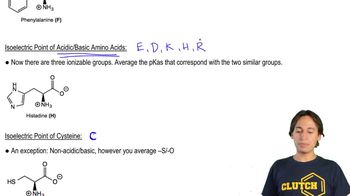
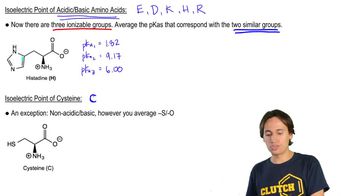
Amino acids with acidic or basic side chains, such as histidine, require a different method for pI calculation.
How do you choose which pKa values to average for amino acids with acidic or basic side chains?
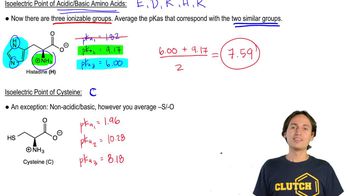
You average the pKa values of the two most similar ionizable groups, usually the side chain and either the carboxyl or ammonium group.
For histidine, which two pKa values are averaged to calculate its pI?
For histidine, the pKa values of the side chain (6.00) and the ammonium group (9.17) are averaged.
What is the calculated isoelectric point (pI) of phenylalanine?
The isoelectric point of phenylalanine is 5.48, calculated by averaging its carboxyl and ammonium pKa values.
Why is cysteine treated as a special case in pI calculations?
Cysteine is unique because its ionizable side chain contains sulfur, which is treated as similar to oxygen for pI calculations.
Which pKa values are used to calculate the pI of cysteine?
For cysteine, the pKa values of the carboxyl group and the sulfur-containing side chain are averaged.
What is the calculated isoelectric point (pI) of histidine?
The isoelectric point of histidine is 7.59, calculated by averaging the pKa values of its side chain and ammonium group.
What is the calculated isoelectric point (pI) of cysteine?
The isoelectric point of cysteine is 5.07, calculated by averaging the pKa values of the carboxyl group and the sulfur side chain.
How many of the 20 amino acids have their pI calculated by simply averaging the carboxyl and ammonium pKa values?
Fourteen out of the twenty amino acids use this straightforward averaging method for pI calculation.
 뒤로뒤로
뒤로뒤로
 02:28
02:28