Skip to main content
Organic Chemistry
나의 코스
배우기
시험 준비
AI 튜터
학습 가이드
교과서적 해결책
플래시카드
탐험해 보세요
앱을 사용해 보세요
나의 코스
배우기
시험 준비
AI 튜터
학습 가이드
교과서적 해결책
플래시카드
탐험해 보세요
앱을 사용해 보세요
뒤로
Metal Ion Catalysis definitions
카드를 뒤집기 위해 탭할 수 있습니다.
Metal Ion Catalysis
카드를 뒤집기 위해 탭할 수 있습니다.
👆
Metal Ion Catalysis
A process where charged metals enhance reaction rates by forming complexes that activate substrates or water molecules.
진행 상황 추적
컨트롤 버튼이 '내비게이션' 모드로 변경되었습니다.
1/15
관련 플래시카드
관련 실천
추천 영상
Metal Ion Catalysis quiz
Metal Ion Catalysis
15 용어
Metal Ion Catalysis
31. Catalysis in Organic Reactions
5 문제점
주제
Metal Ion Catalysis: Water Activation
31. Catalysis in Organic Reactions
5 문제점
주제
31. Catalysis in Organic Reactions - Part 1 of 2
4 주제
12 문제점
장
31. Catalysis in Organic Reactions - Part 2 of 2
4 주제
12 문제점
장
VideoThumbView.guidedCourse
3:39
Metal Ion Catalysis Concept 1
625
views
VideoThumbView.guidedCourse
2:18
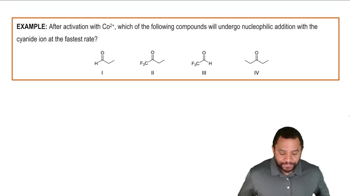
Metal Ion Catalysis Example 1
632
views
이 집합의 용어 (15)
하이드의 정의
Metal Ion Catalysis
A process where charged metals enhance reaction rates by forming complexes that activate substrates or water molecules.
Coordination
A metal forms a bond with an electron-rich atom, increasing substrate reactivity or stabilizing leaving groups during reactions.
Water Activation
Conversion of water into a more reactive nucleophile via interaction with a metal, enabling efficient hydrolysis under mild conditions.
Carbonyl Carbon
An atom in a carbonyl group whose reactivity toward nucleophiles is increased by metal complexation.
Nucleophile
A species that donates an electron pair to form a new bond, often attacking activated carbons in catalyzed reactions.
Leaving Group
An atom or group that departs with a pair of electrons during a reaction, its stability enhanced by metal coordination.
Hydrolysis
A reaction involving water splitting into ions, with its rate increased by metal ions forming reactive complexes.
Metal Hydroxide Complex
A structure where a metal ion is bonded to hydroxide, creating a potent nucleophile under physiological conditions.
Physiological pH
A near-neutral environment, around 7.4, where metal-catalyzed water activation is crucial due to low hydroxide availability.
Nucleophilic Addition
A reaction where a nucleophile forms a bond with an activated carbon, often facilitated by metal ion catalysis.
Nucleophilic Substitution
A process where a nucleophile replaces a leaving group, with metal ions enhancing the reactivity of the substrate.
Electron-rich Atom
An atom with lone pairs that can coordinate with metals, increasing the atom's reactivity in catalyzed reactions.
Partially Positive Charge
A slight positive character developed on atoms or metals upon coordination, influencing reactivity and stability.
Catalyst
A substance, often a metal ion, that increases reaction rates without being consumed, typically by activating reactants.
Complex
An assembly formed when a metal ion binds to other atoms or molecules, altering their chemical properties.
 뒤로뒤로
뒤로뒤로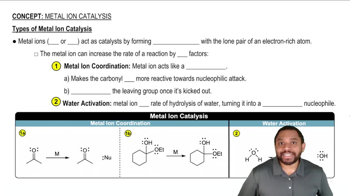
 3:39
3:39